- Using a sales appointment setting service means outsourcing the earliest stages of your sales cycle. Instead of making your internal team hunt for leads, these dedicated professionals handle the targeting, initial outreach, and qualification processes to deliver ready-to-meet prospects right to your door.
- Before contracting a sales appointment setting service, define your criteria for a qualified appointment. You can only accurately compare provider pricing and volume guarantees once you distinguish a raw booked calendar event from a held, sales-accepted meeting.
- Up-front prices can be misleading until you clarify exactly what you’re paying for. Whether it’s a retainer, per-meeting, or hybrid model, you have to evaluate the actual scope of work and the behaviors the pricing structure rewards.
- Outsourcing fits best when an external team can learn enough about your market and sales motion to represent it effectively, while your company keeps ownership of the feedback and decisions needed to improve the program.
The right sales appointment setting service to use isn’t necessarily the one with the most meetings or that promises success. You need a full understanding of everything that goes on behind the contract.
Critical aspects to consider include what actually qualifies as a successful meeting handover, what assets and information you keep if the relationship ends, and how downstream outcomes are tracked and measured. A provider should actively learn from your internal sales team as well.
Understanding these details will give you a consistent framework to compare proposals and decide if outsourcing fits your sales motion.
What is a Sales Appointment Setting Service?
A sales appointment setting service is an outsourced sales function that handles the heavy lifting of prospecting. These partners offer a combination of targeting, outreach, qualification, and scheduling for your sales team. However, you shouldn’t treat every sales appointment setting provider as interchangeable. The exact service you receive depends on your company’s specific needs.
Clarify what you get from a sales appointment setting service
When you contract this type of service, you’re essentially buying the accepted outcome and how responsibilities are divided to achieve it. Before comparing vendors, first decide the exact job you want an outside team to own.
Once you define that responsibility, you need to establish clear operating controls to track the service’s performance. Ask direct questions about ownership: Who handles list building and messaging? Who manages outreach and qualification? Who takes care of calendar coordination, CRM updates, and team feedback?
That segmentation of duties should help guide your vendor comparisons. A useful proposal review explicitly names who does the work before the first touch, during the outreach phase, the information required for a handoff, and the records created after the meeting is booked.
Mapping this out exposes service gaps early. For instance, one provider might handle calling and scheduling but leave account selection and messaging approval to your team. Another may own the entire workflow from start to finish. Even if both vendors sell B2B appointment setting, you’re purchasing two completely different services.
Define a Qualified Appointment Before You Compare Results
Projected meeting volume is a useful metric only if every provider defines a successful meeting the same way. A booked calendar event, a held conversation, a sales-accepted lead, and a progressing opportunity are all distinct outcomes. If one provider bills based on raw bookings while another measures success through held meetings, their advertised totals are measuring completely different things.
Separate booked, held, accepted, and converted outcomes
A meeting that occurs and a meeting that reaches a later sales stage aren’t the same event. Before you compare providers, define what “acceptance” looks like for your company. Specify the account and contact criteria, the buyer role or use case that qualifies, the information the setter must capture, and any conditions that make the meeting ineligible. Then decide which downstream results you want the provider and sales team to see after handoff.
Set rejection and remediation rules before launch
Decide who can reject a meeting, how the reason is recorded, how quickly the provider receives that feedback, and what remediation applies under the contract. Some providers offer replacement or credit terms, while others use coaching and targeting changes.
The goal is to connect the billable outcome to a shared definition. When both sides know what counts, meeting volume becomes more comparable, and the feedback can improve future targeting and qualification while reducing arguments about lead quality.
Keep at least one downstream end point visible even when the provider’s responsibility stops at the meeting stage. That way, you can see if the meetings entering your sales process fit the outcome you agreed upon in the service contract. Monitor sales acceptance, opportunity creation, or another stage your revenue process already uses to gauge that progress.
Track post-meeting metrics to gauge true quality
Continue tracking the life cycle of a lead after the appointment is booked. While the provider may not own these sales metrics, monitoring them is the only way to prove the meetings entering your pipeline match the criteria you agreed to buy. To ensure your qualification standards are working, track at least one of these post-meeting metrics:
- Show Rate: The percentage of booked meetings that actually take place (a strong indicator of lead intent and reminder effectiveness)
- Sales-Accepted Leads (SAL): The percentage of held meetings that your internal sales team accepts as legitimate, qualified prospects
- Pipeline Value Created: The total dollar amount of qualified opportunities generated directly from the provider’s appointments
- Lead-to-Close Ratio: How many of these appointments ultimately convert into paying customers
Over time, these patterns will reveal if your program needs to pivot its target accounts, buyer roles, qualification questions, or messaging.
Compare the Operating Model Behind the Service
Sales appointment setting service providers have different labels, such as dedicated, fractional, shared, capacity-based, and hybrid. The differences lie in who does the work, how much context they carry, what your team must supply, what systems and assets each side controls, and how quickly learning reaches the people doing outreach.
Staffing and enablement
Ask your sales partner about the SDRs assigned to your account. Clarify whether they’re dedicated to your program or shared across clients, who coaches them, who updates messaging, and how product or market changes reach them. The goal is to understand how much attention and context the outreach team will have.
For example, one provider might assign a dedicated SDR who’s trained on your market, messaging, and objections. Another may spread rep time across several accounts. That difference affects how much context the people speaking for your company can carry into conversations.
Also, ask who manages the program around the SDR. Research, data work, coaching, quality review, campaign strategy, and reporting can sit with different people across providers. Knowing the managerial layer helps you understand what your own sales leader will still need to handle.
Data, CRM, and asset ownership
Trace where the campaign data and assets live. Confirm which CRM stores activity and disposition history, who owns campaign lists and messaging, and whether dedicated email or calling infrastructure can be transferred. Ask what you can export and reuse if the engagement ends, since those rights affect continuity and switching costs.
For example, one program may log outreach, dispositions, and meeting history directly in your CRM. Meanwhile, another may keep most campaign activity in its own platform and just send reports back to you. Before launch, confirm what you can access and export if the relationship ends.
Feedback and program changes
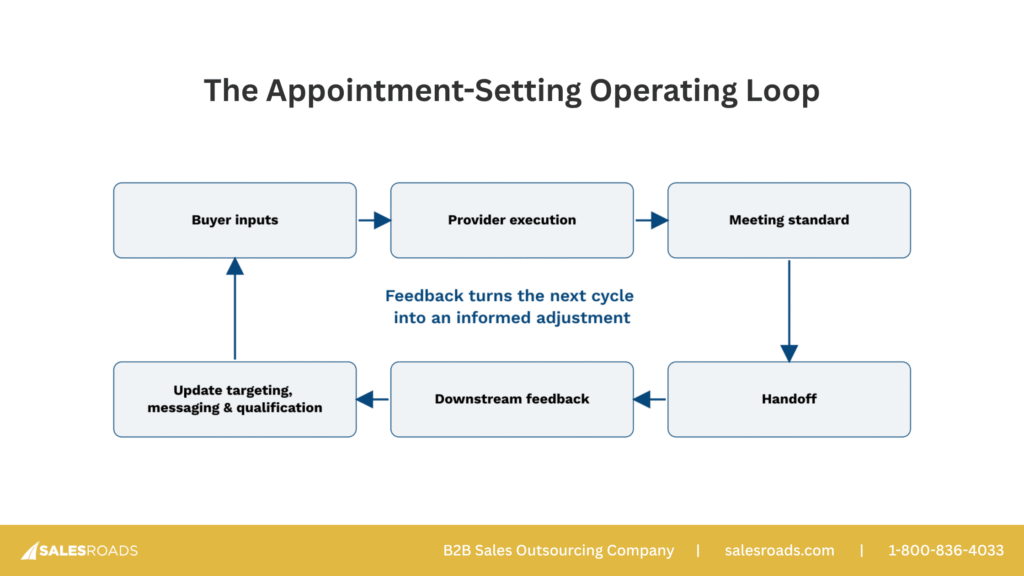
Outsourcing still requires an active feedback loop. The provider needs enough context about your ICP, product, messaging, objections, and qualification rules to represent the offer accurately. Your sales team then needs a simple way to return meeting feedback to the people running outreach.
For example, your AEs might mark each meeting as accepted or rejected and record the reason. The provider can use that feedback in the next review to adjust targeting, qualification rules, messaging, or coaching. If the feedback never reaches the outreach team, the same problem can repeat.
Compare Pricing Models Based on What the Fee Includes
Appointment-setting quotes are hard to compare when providers charge for different services. One fee may cover a managed SDR program with research, technology, management, and reporting, while another might charge mainly for each meeting booked. Before comparing agency pricing models, identify what the fee includes, what your team still has to provide, and what result triggers payment.
Retainer-based services
With a retainer, you pay a flat, recurring fee for a dedicated team and an agreed-upon scope of work. Depending on the provider, this typically covers SDR time, management, prospect research, outreach tools, data licensing, and ongoing campaign strategy.
Best fit for: Companies with complex, long sales cycles, high-ticket B2B products, or niche target markets. A retainer is ideal if you need outsourced SDRs to act as a seamless extension of your brand, require highly consultative outreach, and value predictable monthly costs over raw, transactional meeting volume.
Pay-per-appointment services
With pay-per-appointment pricing, part or all of the provider’s fee depends on the number of meetings they book that meet the contract’s billing definition. Because you only pay for outcomes, specifying qualification criteria, rules for no-shows, and dispute processes is critical before comparing costs.
Best fit for: Companies with shorter sales cycles, straightforward value propositions, and broad target audiences. It’s well suited for businesses with strict performance budgets that need immediate ROI and a large number of top-of-funnel conversations rather than highly customized, account-based research.
Hybrid pricing
Hybrid pricing blends the two models, combining a recurring base fee with payment tied to defined results. The base fee typically covers data, technology, and management, while the variable fee acts as a performance bonus triggered by held or sales-accepted meetings.
Best fit for: Growth-stage companies that want shared risk and reward. This is ideal if your campaign requires heavy lifting up front, but you still want the provider highly incentivized to deliver qualified calendar bookings.
What changes the quoted price
Price can change based on certain criteria, including:
- The number and seniority of reps assigned
- Target market difficulty
- Outreach volume
- Channels and technology used
- List or data work
- Onboarding
- Managerial support
- Reporting
- Geography or language needs
- The qualification standard you require
Compare those differences in scope alongside the monthly or per-meeting price. A proposal with a larger recurring fee may include data, management, technology, and reporting that a lower-priced offer leaves with your team. The total workload on your side matters when you compare costs.
Decide Whether Outsourcing Fits Your Sales Motion
Sales outsourcing fits when your team wants more prospecting execution or a managed outbound program and can give an external team enough market, product, and qualification context to work effectively. Conversely, in-house or hybrid execution makes more sense when the sales motion changes quickly or depends on intimate product and account knowledge.
When outsourcing can extend your prospecting team
An outside provider is easier to integrate when your team can clearly define target accounts, buyer roles, the problem you solve, qualification rules, and who owns feedback. You also need an internal owner who can review what the provider is hearing and make timely decisions.
The outside team can take prospecting work off your sellers while your company handles the decisions that shape the program. This arrangement is especially useful when your closers need more time for active opportunities, and your company wants a managed prospecting layer around them.
When in-house or hybrid execution fits better
Keep more of the work close to your team when prospecting depends on rapid product learning, highly technical discovery, strategic-account research, or executive context that changes substantially by account. A hybrid structure can also work when your internal SDRs own one segment or channel and an outside team owns another.
Define the split clearly; accounts, channels, qualification rules, CRM fields, and feedback should have named owners. If you’re choosing between adjacent outsourced programs, learn the differences between appointment setting and lead generation to help clarify whether you need booked sales conversations or deeper market research and qualification.
Use a Due-Diligence Scorecard Before You Sign
Proposals are much easier to evaluate when you have providers back up their sales pitches with concrete, verifiable processes. To keep the playing field level, ask every shortlisted service the same questions.
You can adapt the sample scorecard below and use it in two instances during your evaluation: First, use it to guide your initial proposal calls; then use it again during the contract review to determine which services are guaranteed in writing, which promises are still vague or unconfirmed, and what specific details must be added to the final agreement.
| Area | Verify before signing | Evidence to request |
|---|---|---|
| Accepted meeting definition | What must be true for a meeting to count? | Written acceptance criteria and rejection process |
| Downstream measurement | Which states remain visible after booking? | CRM fields, stage definitions, and reporting sample |
| Staffing and client involvement | Who works the account, and what does your team still own? | Team roles, management cadence, and enablement plan |
| Data, CRM, and asset ownership | Where do data and campaign history live, and what can be exported? | Data terms, CRM workflow, asset ownership, or export language |
| Reporting, feedback, and remediation | How are rejected meetings and sales feedback turned into changes? | Review cadence, feedback workflow, coaching, or remediation terms |
| Commercial unit and incentives | What triggers payment, and what scope is included? | Fee schedule, scope, acceptance rule, variable-payment terms |
| Channel safeguards | Which outreach channels and technologies are used, and how are they governed? | Process documentation for calling, email, consent, opt-out, records, and platform controls as applicable |
| Exit and transition | What happens to data, history, assets, and active work when you leave? | Termination terms, export process, and transition checklist |
Missing information is a major red flag. If a provider can’t clearly explain their acceptance rules, feedback loop, or exit terms before you sign, you should strongly consider crossing them off your shortlist. Don’t let a slick presentation hide a lack of operational substance.
Ask for concrete compliance workflows
For outbound calling, channel governance is also an important selection question. The FTC’s 2024 Telemarketing Sales Rule amendments prohibit material misrepresentations and false or misleading statements in B2B telemarketing calls and expand recordkeeping requirements. The FCC has also clarified that AI-generated or other artificial and prerecorded voice technology falls within the TCPA artificial or prerecorded voice framework.
If a provider uses this technology, ask exactly how they remain compliant. You need to know how they secure consent, manage opt-outs, handle sensitive prospect data, and maintain the required audit trails. Don’t assume broad B2B rules will automatically protect you.
The same principle applies to other channels. Ask what specific infrastructure the provider uses, such as dedicated email sending domains, sender reputation monitoring, or encrypted CRM integrations, and evaluate how they safeguard your brand. A generic compliance badge is less informative than a concrete explanation of the workflow your campaign will run.
A fully managed sales appointment setting service will handle these operating controls transparently for you, integrating everything from initial playbook creation and CRM setup to SDR coaching, secure data handling, and a seamless appointment handoff.
Choose the Operating Model You Can Manage and Measure
Selecting an appointment-setting provider comes down to understanding the operating details behind the proposal. Before signing, confirm what counts as a qualified meeting, who owns each process, what the fee actually covers, and how your team’s feedback will shape future outreach.
Match these answers against your internal capabilities. A team seeking a fully managed outbound function will evaluate candidates very differently from one simply needing extra calling hours. Make sure you resolve any lingering ambiguity around pricing, lead qualification, or exit terms before committing.
If your goal is to build a comprehensive outbound engine, you need a full-suite appointment setting service like SalesRoads. We’ll provide the dedicated SDR execution, playbook development, prospect research, and ongoing optimization required to launch and manage a seamless system. Book a call with our team to see if this model aligns with your market and pipeline goals.
Frequently Asked Questions About Sales Appointment Setting Services
Can an appointment-setting service work alongside an internal SDR team?
Yes. A hybrid model can divide prospecting work between an outside provider and internal SDRs. Define which accounts, segments, channels, or stages each side owns, keep messaging and qualification rules aligned, and specify the handoff. The model works through a clean responsibility split and a shared feedback process. Both teams can remain active.
What happens if a booked meeting is unqualified or a no-show?
The agreement should define how the event is classified and what happens next. Set the acceptance criteria, who can reject a meeting, how the reason is recorded, and what remediation applies. A provider may offer replacement or credit terms or address the issue through targeting, qualification, and coaching changes. Remedies vary by provider.
Do outsourced sales appointment setting services usually include data, CRM access, and outreach infrastructure?
The scope of offerings varies by provider and SLA. Ask each potential provider who supplies prospect data, which CRM stores activity and dispositions, what outreach infrastructure is used, and whether lists, messaging, history, or dedicated assets can be exported. Clarify what your purchase includes and what stays under your control if the engagement changes.
What should I take with me if I change appointment-setting providers?
Preserve the assets and learning you’re entitled to keep under the agreement. That can include CRM history, prospect and account data, qualification definitions, messaging and playbook assets, reporting definitions, campaign learnings, and client-owned channel infrastructure. Confirm the export and transition process before launch so the next team can inherit context and avoid a complete rebuild.