- B2B appointment setting is a comprehensive sales-development process. It identifies target accounts and buyer roles, engages them with a clear reason to talk, qualifies the fit, and schedules a context-backed conversation with the appropriate closing team.
- Booking a meeting only drives value when specific criteria are met well before the invite goes out.
- Transferring detailed notes is critical for a smooth transition from the SDR to the closing representative. If you don’t capture why a prospect agreed to talk, you’ll force the seller to restart discovery from scratch.
- Post-meeting outcomes reveal process failures, allowing teams to trace symptoms like repeated wrong-role meetings or frequent no-shows back to specific flaws in their targeting or messaging.
- Partnering with a managed service provider ensures every stage of the outbound motion stays connected and doesn’t drop vital context before generating a highly qualified pipeline.
A fully booked calendar can look like progress until the sales team starts preparing for the meetings. If the wrong accounts show up, qualification is vague, or the handoff gives the seller little context for why a prospect agreed to talk, meeting volume loses its value as the motion struggles to produce useful sales conversations.
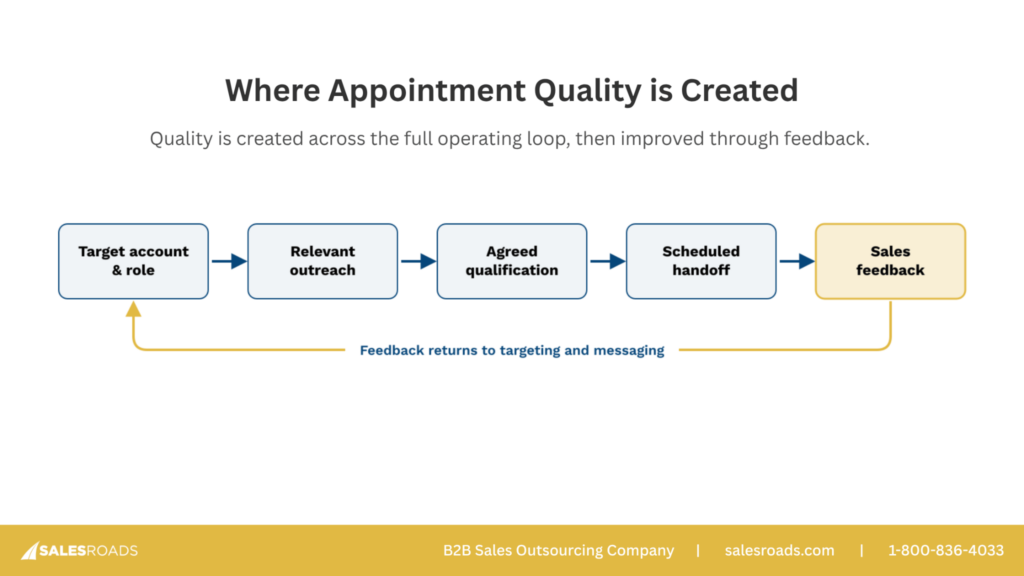
B2B appointment setting works as a connected sales-development process. The team decides which accounts and roles are worth pursuing, creates a relevant reason to engage, learns enough through outreach to decide if the conversation should advance, and carries that context into the handoff.
The goal is to secure a sales conversation that makes sense for both sides and gives the sales team enough context to take the next step. What happens in that conversation should then inform the next cycle of targeting, messaging, qualification, and handoff.
What is B2B Appointment Setting?
B2B appointment setting identifies target accounts and relevant buyer roles, engages them with a reason to talk, qualifies whether a sales conversation makes sense, and schedules that conversation with the appropriate sales team.
Unlike basic calendar scheduling, the process begins before outreach and continues through the handoff and feedback loop. Targeting and data determine which accounts and roles are worth pursuing and who can actually be reached, while messaging and qualification establish why the buyer would engage and whether the conversation should advance. The handoff carries that context into sales, and feedback shows what should change in the next cycle.
How B2B appointment setting differs from lead generation
Lead generation and appointment setting can overlap, but they don’t have the same end point. While lead generation may identify, research, qualify, or warm prospects for later follow-up, B2B appointment setting advances an appropriate prospect into a scheduled sales conversation and carries enough context forward for that conversation to be useful.
How the B2B Appointment Setting Process Creates a Sales Conversation
Every step in the B2B appointment-setting process must deliver useful output to the next stage. The goal is to engineer a high-quality conversation. That requires a carefully staged approach where each phase progressively builds the buyer’s interest and gathers critical context, making the eventual transition to formal sales discovery seamless.
Decide who to have a conversation with
The first job is defining the account and role coverage that makes a sales conversation genuinely useful. This phase starts with defining the ideal customer profile (ICP), account priorities, specific buyer roles, and meaningful exclusions, such as rejecting companies below a certain revenue threshold. The team then uses dedicated research and validation to find current, reachable decision-makers inside those accounts. The final output is a focused set of relevant targets the team can credibly pursue, fully supported by accurate contact information.
Give the buyer a reason to engage
Next, the team turns the core offer, use cases, account context, and buyer priorities into a compelling reason for the lead to agree to talk. In-depth research is important to stay relevant during the conversation, allowing the setter to reference a recent company merger or a new executive hire, for example. Strong messaging then helps the prospect clearly understand how the outreach connects to a specific problem, operational change, or overarching business priority that deserves immediate attention.
Turn outreach into enough context to justify the next conversation
Active outreach produces response signals and live conversations. In turn, those give the appointment setter enough information to test the agreed-upon account, contact, and conversation criteria. Although a positive email reply is one signal inside that decision matrix, the interaction also needs to clarify who’s involved in the buying process, why the prospect is currently willing to talk, and what specific challenges the sales team should expect to address next.
Preserve that context through the handoff
Once the meeting is booked, the underlying reason for the conversation has to survive the transfer to the closing team. The account executive should receive relevant account history, the participant’s exact role, the specific pain point that prompted the engagement, and any useful questions or concerns that surfaced during prospecting. When those details disappear, a blank calendar invite forces the seller to rebuild the context that the appointment-setting work had already established.
These decisions depend heavily on one another, meaning stronger contact data won’t compensate for an unclear reason to engage. Likewise, a positive initial conversation can still lose its value if the final handoff drops the context that created it. You need consistent feedback here as well to show the team what needs to be adjusted and where they can improve.
Broad role coverage is especially important in complex B2B purchases, since a single contact usually represents only a small fraction of the entire buying committee. Forrester research reports that B2B buying decisions involve 13 internal stakeholders and nine external influencers, and those numbers increase for highly strategic purchases. Target-account work often needs to identify several relevant roles across the target company so the outreach team isn’t building the entire motion around one person who lacks final purchasing authority.
| Decision point | What it needs to produce |
|---|---|
| Account and role selection | A focused set of accounts and relevant buyer roles worth pursuing |
| Reachability and context | Current, usable account, and contact information that improves the next decision |
| Reason to engage | A clear, buyer-relevant reason for the conversation |
| Response and learning | Live response signals and context about what matters to the prospect |
| Conversational fit | A grounded reason to advance or stop the conversation |
| Context transfer | A scheduled meeting with the reason for the conversation preserved for sales |
| Sales feedback | Specific learning that changes targeting, messaging, qualification, or handoff |
The Core Requirements of a Sales-Ready B2B Appointment
A worthwhile B2B appointment starts with a clear match between the target account, the specific participant, the reason for the conversation, and what your sales team needs to do next. The account should fit the overall sales motion, meaning it meets necessary revenue or industry criteria, and the participant must be ready to buy.
According to Gartner, 73% of respondents ignore agencies that blast irrelevant outreach. That makes relevance a practical quality test for appointment setting. However, your baseline conversion expectations shouldn’t rely solely on industry averages; use your own historical sales data.
Teams can evaluate prospects using the five checks below. While the exact qualification criteria varies depending on the specific sales motion, the SDR team needs to know why this account, this person, and this conversation belong together before the scheduled meeting consumes valuable selling time. Be sure every meeting has:
- Account fit: Verify company criteria like company size, industry, or current tech stack.
- Buyer relevance: Ensure the prospect actually influences or owns the purchasing decision.
- Reason to engage: Confirm the prospect understands exactly why they’re taking the meeting.
- Conversation fit: Check that the prospect’s current challenges align with your core offer.
- Sales context: Capture the specific notes and background details that the closer needs for a smooth handoff.
These required checks shape what happens before a calendar invite goes out. Weak buyer relevance sends the team back to account or role selection, an unclear reason to engage points directly to the messaging strategy, and missing sales context exposes a handoff problem. By closely monitoring these areas, meeting quality stays firmly tied to the sales conversation the team crafts, giving the calendar invite a proper role within the larger process.
Why B2B Appointment Setting Breaks Down (And How to Fix It)
Poor appointment quality usually appears during the actual sales call, but the root cause often sits much earlier in the outbound motion. Feedback effectively closes the loop between the scheduled appointment and the initial decisions that led to it. After a meeting ends, the sales team can return useful information about who attended, if the expected use case was accurate, what the prospect wanted to discuss, and where the conversation moved forward or stalled out.
Tracking these downstream outcomes enables teams to trace specific symptoms back to the operational decisions that produced them. Potential fixes for common breakdowns in the operating chain include:
- Plenty of contacts but few conversations: Evaluate account selection, contact validity, and channel execution to see if the team is calling outdated numbers or emailing unattended inboxes.
- Prospects respond but rarely agree to meet: Adjust relevance or value framing, since the outreach creates attention but fails to provide a compelling business reason to book a call.
- Repeated wrong-role meetings: Send the team directly back to targeting and buyer-role selection to exclude lower-level titles that completely lack purchasing authority.
- Misaligned expectations between the prospect and seller: Expose messaging or qualification problems, such as a setter inadvertently pitching a timeline the delivery team can’t meet.
- Frequent no-shows: Require tighter scheduling workflows or a more structured pre-meeting confirmation cadence.
- Meetings reach sales with almost no usable context: Inspect the internal handoff itself, as the setter might be failing to log vital CRM notes before passing over the calendar invite.
Front-line signals can move in the other direction too. Early objections, email response patterns, and routine call reviews pinpoint where account selection, message framing, qualification criteria, or individual rep coaching needs immediate adjustment.
B2B Appointment Setting in Practice
Cloud-based software provider AchieveIt needed a unified system where target-list development, playbook creation, and active SDR execution constantly informed one another to improve meeting quality.
SalesRoads stepped in to provide a dedicated SDR team that worked directly from a highly customized playbook, and the process didn’t stop once a meeting hit the calendar. The SDRs captured the context that prompted the prospect’s engagement, such as a specific frustration with their current strategic planning software or a recent shift in management. This ensured vital information survived the handoff to AchieveIt’s closing team so the account executive could pick up the conversation seamlessly without asking the prospect to repeat themselves.
The closed feedback loop between the frontline SDRs and AchieveIt became the primary driver for ongoing improvement. Both teams had complete access to call recordings, meaning campaign messaging and overall execution could be refined collaboratively. Whenever a prospect provided new objections about budget constraints or highlighted a unique use case for tracking company-wide KPIs, that frontline feedback immediately flowed back into the system. The team would then adjust target-account parameters and update the playbook for the next cycle of calls.
That tight connection between initial playbook development, complete call visibility, and ongoing adjustment turned individual outbound activities into a continuous learning loop. Over the life of the campaign, that connected motion allowed AchieveIt to set 937 appointments and generate $27 million in the sales pipeline.
Building a Connected Appointment Setting Motion
Effective B2B appointment setting requires much more than just high activity volume or a crowded calendar. It functions as a connected operational chain where every decision, from detailing your ICP to capturing specific buyer frustrations during the final handoff, must leave your sales team with actionable context.
If you’re ready to transform your B2B appointment process but lack the capacity to do so internally, partner with an expert team to run the entire appointment-setting process for you. SalesRoads specializes in building and executing that seamless outbound motion, ensuring your closers receive highly qualified meetings backed by the context they need to successfully win the deal. Reach out to our team today to discuss how our managed appointment-setting services can drive a viable pipeline for your specific sales motion.
Frequently Asked Questions
How long does it typically take to see results from a new B2B appointment-setting campaign?
It usually takes between 30 and 90 days to see consistent, highly qualified meetings hit the calendar. The first month focuses heavily on foundational work, such as building targeted prospect lists, warming up email domains, and testing initial messaging angles. By the second and third months, the SDR team has enough frontline data to refine their approach based on actual buyer responses.
What key performance indicators should be tracked besides the total number of meetings booked?
Teams should closely monitor metrics that indicate the overall quality and efficiency of the campaign. Important operational KPIs include the show rate to track how many prospects actually attend the scheduled meeting, the sales-accepted opportunity rate to measure how many appointments turn into viable pipeline, and the positive reply rate on outbound emails to actively gauge messaging resonance.
What technology tools are required to run an effective appointment-setting motion?
A modern appointment-setting team relies on a connected stack of software to securely manage and track outreach at scale. This foundation typically requires a robust B2B contact data provider to source verified direct-dial phone numbers and active emails, paired with a sales engagement platform to build and automate multichannel outreach sequences. Additionally, the team needs a reliable customer relationship management system to capture call notes and seamlessly manage the final context handoff to the closing team.
How do appointment setters handle common buyer objections during initial outreach?
Professional appointment setters don’t try to aggressively overcome every single objection. Instead, they use those moments as an opportunity to better understand the buyer’s current environment. By uncovering these minor frustrations, the setter can pivot the conversation toward a highly relevant value proposition and logically justify booking a brief discovery call.
Should an appointment-setting team use different strategies for inbound leads versus outbound targets?
Yes, the operational approach must adapt to the prospect’s current level of intent. Inbound leads usually require incredibly fast response times and highly specific follow-up based on the exact asset they downloaded or the web form they recently submitted. Outbound targets, on the other hand, require a carefully orchestrated, multi-touch sequence designed to respectfully disrupt their day and educate them on a business problem they might not even realize they have.