Leadership wants to know what went wrong. Sales managers defend their teams, citing market conditions, product gaps, or bad luck with timing. Finance recalculates the revenue projections while marketing questions whether they’re generating enough leads. And your reps are somewhere between demoralized and resigned, already bracing for next quarter’s targets that feel just as unreachable.
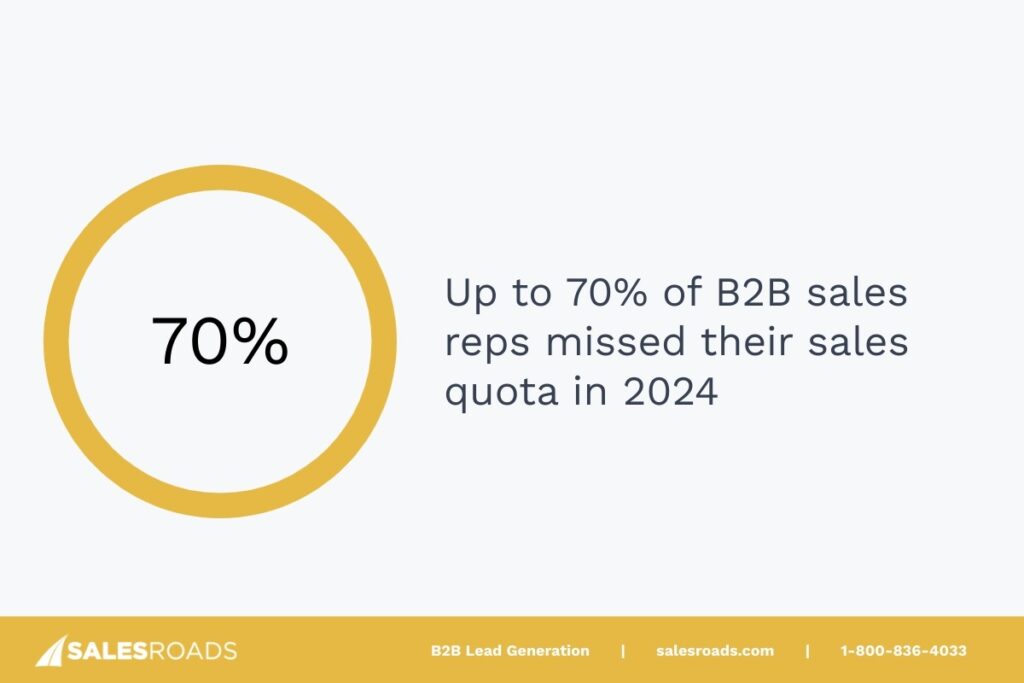
It’s more common than you might think. In fact, research reveled that almost 70% of B2B sales reps missed their sales quota in 2024.
And it’s not about working harder or wanting it more. When quota attainment is consistently mediocre across your organization, you don’t have an execution problem; you have a systems problem.
Sales Quota Attainment Pitfall #1: Setting Unrealistic Quotas
The most fundamental mistake in sales quota management is setting targets that have no basis in reality. This happens when leadership works backward from revenue goals rather than forward from market data, historical performance, and available resources.
When reps do the math and realize their targets are unattainable, they either game the system, focus only on what’s achievable and ignore the rest, or start looking for new jobs.
You end up with sandbag forecasts, manipulated pipeline data, and a culture where nobody believes the numbers.
How to Fix
- Start with data. Build quotas from the bottom up using historical win rates, average deal sizes, sales cycle lengths, and territory potential. Analyze your top performers’ results over multiple quarters to understand what’s genuinely achievable.
- Factor in market saturation, competitive dynamics, and seasonal patterns. If closing a deal requires 20 qualified conversations, and a rep can realistically have four quality conversations per day, the math tells you what’s possible.
- Test your assumptions with territory analysis. Break down your market by segment, region, and account size. Calculate the total addressable opportunity in each territory and work backward to quotas that reflect actual potential.
- Involve frontline managers in quota-setting. They understand the ground truth better than anyone in the executive suite. When managers have input and buy-in on the targets their teams will carry, they’ll set challenging but achievable numbers and commit to helping their reps get there.
Sales Quota Attainment Pitfall #2: Poor Sales Pipeline Visibility
You can’t manage what you can’t see.
Organizations that lack clear, real-time visibility into their sales pipeline are essentially flying blind. Reps provide optimistic forecasts, managers accept them at face value, and leadership is shocked when deals slip or disappear entirely. By the time anyone realizes quota is at risk, it’s too late to course-correct.
Poor pipeline visibility manifests in several ways: inconsistent stage definitions that mean different things to different reps, deals that linger in the pipeline for months with no real progression, inflated probability assessments that don’t match historical conversion rates, and phantom pipeline filled with opportunities that were never really qualified.
How to Fix
- Implement clear, objective stage definitions tied to buyer actions rather than seller activities.
- Establish pipeline hygiene standards and enforce them religiously. Require regular pipeline reviews where managers dig into deal details, not just accept reported numbers. Implement aging reports that flag deals sitting too long in any stage.
- Create automatic alerts when opportunities haven’t been updated within a specific timeframe. Make pipeline cleanliness a performance metric that matters.
- Deploy pipeline coverage metrics that tell you whether each rep has enough qualified opportunities to hit quota. Track this weekly so you can spot problems months before quota attainment is at risk.
Sales Quota Attainment Pitfall #3: Ignoring the Middle Performers
Sales organizations tend to operate in extremes. They celebrate top performers, create performance improvement plans for the bottom tier, and completely neglect reps in the middle. These middle performers represent the biggest untapped opportunity in most sales organizations.
The problem is that middle performers become invisible. They’re not failing badly enough to trigger intervention, but they’re not succeeding enough to earn recognition or resources.
They plateau, gradually lose confidence, and eventually either drop into the bottom tier or leave the organization. Meanwhile, leadership keeps hiring more reps to fill the gap rather than elevating the team they already have.
How to Fix
- Recognize that small improvements across your middle tier drive more revenue than trying to replicate your top performers. If you have ten middle performers averaging 80% quota attainment, getting them to 95% produces more total revenue than hiring two new reps who’ll spend six months ramping.
- Conduct skill gap analysis specifically for your middle performers. Maybe they’re great at discovery but weak at handling objections. Identify the specific capability that’s holding each rep back and provide targeted coaching.
- Create peer learning opportunities between your middle and top performers. Have them shadow calls, review recorded demos, and participate in deal strategy sessions.
- Implement micro-goals that create momentum. Instead of focusing on the gap between current performance and quota, break improvement into achievable increments.
- Assign your best managers to develop middle performers, not just manage top ones. Many organizations reward their best managers by giving them the already-successful reps. Flip this logic. Put your strongest developmental coaches with the middle tier where their impact multiplies.
Sales Quota Attainment Pitfall #4: Lack of Activity Standards and Metrics
Many sales organizations measure outcomes but not the activities that drive those outcomes. They track quota attainment, deal velocity, and win rates while remaining fuzzy about what specific actions consistently produce results.
This creates a black box where successful reps “just figure it out” and struggling reps flail without understanding what good actually looks like.
Without activity standards, managers can’t diagnose problems early. A rep might be on track to miss quota by 40%, but without knowing whether they’re making enough calls, conducting proper discovery, or engaging decision-makers, managers default to generic advice like “work harder” or “stay positive.” Meanwhile, the rep continues executing the wrong activities with greater intensity.
How to Fix
- Start by reverse-engineering success. Analyze your top performers’ activity patterns over the past year. How many outbound touches do they make per day? How much time do they spend in discovery versus moving deals forward? Identify the activity patterns that correlate with quota attainment.
- Establish minimum activity standards based on this analysis, but make them leading indicators.. The goal is to ensure sufficient quality activity. Set standards for things like qualified conversations per week, discovery calls with new opportunities, and proposal presentations.
- Create activity dashboards that show both volume and quality sdr metrics. Track not just how many calls a rep made, but how many connected, how long they lasted, and whether they resulted in next steps. Monitor email response rates, meeting acceptance rates, and demo-to-opportunity conversion.
- Use activity data for early intervention to catch problems while there’s still time to fix them. Balance activity metrics with outcome metrics. Activity without results is just motion. Review both together in pipeline meetings.
Sales Quota Attainment Pitfall #5: Inconsistent Management Practices
Sales teams often operate like independent franchises where each manager runs their territory according to their own philosophy.
One manager conducts rigorous weekly pipeline reviews while another checks in monthly. One provides detailed coaching on every call while another subscribes to sink-or-swim development. One holds reps accountable to activity metrics while another only cares about closed deals.
This inconsistency creates massive inequity in the sales organization. Reps with strong managers develop quickly and hit quota reliably. Reps with weak managers struggle, disengage, and either stagnate or leave.
Performance variance across teams often reflects management quality more than territory potential or rep capability, yet organizations continue treating management as an art rather than a discipline.
How to Fix
- Standardize your management cadence across the entire sales organization. Every team should have the same rhythm of one-on-ones, pipeline reviews, forecast calls, and coaching sessions. Create templates and agendas for each type of meeting so managers know what to cover and reps know what to expect.
- Develop a management playbook that documents your sales leadership methodology. What does good pipeline inspection look like? How should managers conduct deal reviews? What’s the process for identifying and addressing performance issues?
- Provide sales training on coaching techniques, performance management, forecasting discipline, and how to use data for decision-making.
- Create manager peer groups where sales leaders share challenges, review each other’s pipeline calls, and learn from one another. The best management practices are often being executed somewhere in your organization.
- Measure management effectiveness, not just team results. Track metrics like team quota attainment distribution, rep ramp time, employee retention, forecast accuracy, and pipeline quality by manager.
- Hold managers accountable to process, not just outcomes. Review whether they’re conducting their one-on-ones, inspecting pipeline quality, and providing documented coaching. Many managers only engage when deals are closing or when someone is clearly failing.
Sales Quota Attainment Pitfall #6: Overreliance on Incentives Alone
Many organizations treat compensation as their primary—or only—lever for driving quota attainment. They believe that if they just get the commission structure right, everything else will fall into place. When reps underperform, the reflexive response is to adjust the comp plan, add accelerators, or introduce SPIFs to drive behavior.
Here’s how David Kreiger explains why SPIFFs should support your strategy, not 𝘣𝘦 your strategy:
But incentives are a terrible primary management tool. Reps might focus only on what’s measured and incentivized while ignoring activities that matter, they game the system to maximize short-term comp at the expense of long-term customer relationships, and they burn out chasing unrealistic targets for payouts that never materialize.
How to Fix
- Recognize that sdr motivation is multifaceted. Sales reps are driven by achievement, mastery, recognition, autonomy, purpose, and belonging, not just money. Create an environment where people want to perform, not just one where they’re paid to perform.
- Fix the fundamentals before tweaking compensation. Address root causes first. Only use incentives to optimize a system that’s already functional.
- Design compensation for clarity and predictability, not complexity. Many sales comp plans are so convoluted that reps can’t calculate their own earnings or understand how their daily activities translate to paychecks.
- Use non-monetary recognition strategically. Many top performers are motivated more by status and recognition than incremental compensation.
- Create team-based incentives alongside individual ones. While sales will always be primarily individual performance-driven, adding team components encourages knowledge sharing, collaboration, and collective problem-solving.
- Survey your team about what actually motivates them. Don’t assume you know. Ask about career development, work-life balance, autonomy, skill-building, and recognition alongside compensation.
Sales Quota Attainment Pitfall #7: Weak Onboarding and Ramp-Up Process
Perhaps no pitfall is more expensive than poor sdr onboarding.
Organizations invest heavily in recruiting, pay signing bonuses and competitive salaries, then essentially abandon new reps to figure things out on their own. They’re given access to the CRM, a few product presentations, maybe some shadowing opportunities, and wished good luck. Six months later, leadership is disappointed that the new hire isn’t producing, not recognizing that they never set that person up to succeed.
Weak onboarding creates a vicious cycle. During that extended ramp, they develop bad habits, lose confidence, and fail to build pipeline.
Some eventually figure it out, but many churn out before becoming productive. This forces continuous hiring to replace underperformers, which strains the onboarding system further and prevents any consistency in team performance.
How to Fix
- Build a structured 90-day onboarding program with clear milestones and competencies. Document exactly what new hires should know and be able to do at each checkpoint.
- Assign dedicated onboarding mentors to every new rep. Pair them with successful peers who remember what it’s like to be new and can answer questions without judgment. Create a buddy system where new hires have someone to debrief with after every call, ask “dumb questions,” and observe in real selling situations.
- Delay quota accountability during ramp. New reps shouldn’t carry full quota in month one. Use graduated quotas—maybe 25% in month one, 50% in month two, 75% in month three, and 100% by month four.
- Create a content library of recorded calls, demos, and presentations organized by use case and scenario. New hires should be able to see how top performers handle common objections, conduct discovery, deliver demos, and navigate negotiations.
- Track time-to-productivity metrics religiously and use them to optimize your onboarding. How long does it take new hires to first meeting, first opportunity, first close? What early indicators predict who will succeed? Use this data to continuously improve your program.
Bottom Line
The organizations that consistently achieve high quota attainment across their teams don’t rely on motivation speeches or compensation gimmicks.
They set realistic targets grounded in data. They provide clear visibility into pipeline health. They invest in developing their middle performers instead of only celebrating their stars. They standardize management practices so every rep gets quality coaching.
The question isn’t whether you can improve quota attainment across your team. You can. The question is whether you’re willing to address the real problems instead of treating the symptoms.