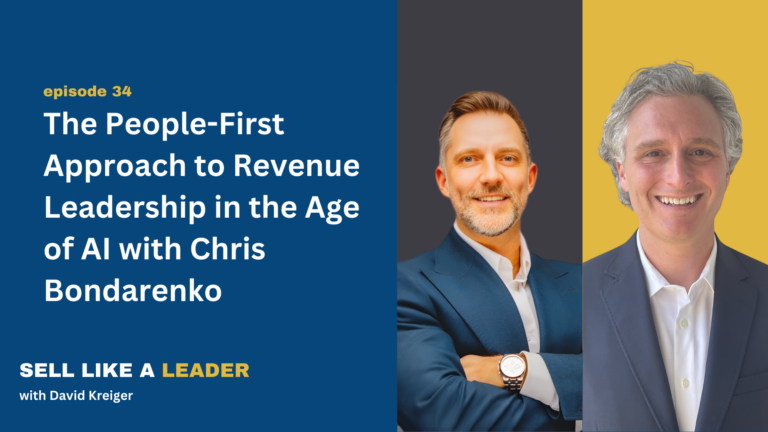
Sell Like A Leader – Episode 34
David Kreiger sits down with Chris Bondarenko, Chief Revenue Officer at 360 Learning, to explore what it really takes to build and scale high-performing revenue teams in today’s rapidly evolving sales environment.
Chris brings a people-first approach to sales leadership that emphasizes the strategic importance of hiring the right personas, developing talent through continuous learning, and understanding where AI actually creates value versus where it falls short.
In this episode, he breaks down:
- Why top sales reps need to think like quarterbacks
- The three specific ways AI helps top performers win
- How to define clear success personas for each sales role and hire against these personas
- The two core revenue processes that must be clearly defined before any SaaS company can scale effectively
You’ll also hear Chris’s perspective on why people will always be the differentiator in sales, the dangers of rushing to automate without considering brand impact, and why leaders need more time to simply think about their business.
About Chris Bondarenko
Chris is the Chief Revenue Officer at 360Learning and an experienced revenue executive with a strong focus on learning and diversity in the workplace.
He is actively involved in professional communities such as Legacy Executive Club and a Mentor for GirlsClub and also works as an early-stage investor and advisor.
Podcast Key Takeaways
- Top performers need to be quarterbacks. The best sales reps coordinate internal resources, external stakeholders, and AI tools to navigate increasingly complex buying committees that now regularly include CFOs and IT leaders alongside traditional decision-makers.
- AI excels at efficiency gains, data analysis, and deal strategy insights, but human relationship-building and execution remain the competitive differentiator, especially in people-focused industries.
- Define clear personas for each sales role based on coachability, mindset, behaviors, and cultural fit—then only hire people who match those personas to build a consistently high-performing team.
- The player-coach role is a transitional trap. While sometimes necessary due to budget constraints, asking someone to simultaneously carry a quota and manage a team creates conflicts of interest and rarely sets new leaders up for long-term success.
Connects
Connect with Chris Bondarenko: https://www.linkedin.com/in/chrisbondarenko/
Connect with David Kreiger: https://www.linkedin.com/in/davidkreiger
Subscribe to the podcast and follow our Podcast LinkedIn page so you don’t miss any episodes!
Transcript
David: Welcome back to another episode of the Sell Like a Leader podcast. The podcast for revenue leaders who are on a mission to cultivate a high performing sales team within their organization. I'm your host, David Krieger, founder of SalesRoads, America's most trusted lead generation and sales outsourcing firm.

Today, we are bringing you another great revenue leader, Chris Bondarenko. Chris is the Chief Revenue Officer at 360 Learning and is an experienced revenue executive with a really strong focus on, yes, you guessed it, learning. He is actively involved in professional communities such as Legacy Executive Club, which is actually how the two of us got to meet.

We are in the monthly group together, and I have just gotten such amazing insights from Chris as we bring sales and business problems. He's a very clear thinker and I just had to have him on the Sell Like a Leader podcast. And so Chris, I really appreciate you being here today.

Chris: David, likewise. Thank you. And yeah, it's been a great experience getting to know you at Legacy and couldn't be more thrilled to have some fun on this today.

David: Yeah. Well, I'm glad, you know, we can't open up on what we speak about at Legacy 'cause it is a small group. But here I wanted to make sure that people get to hear your insights and your approach to leading sales teams, how they learn, AI, all the different things. So let's jump into it.

You know, where I'd love to start is, you know, you have led revenue teams at several different stages of SaaS, and now you're the CRO at a learning focus company. And so I'd love to just start there. How has being in a learning first environment shaped how you develop revenue teams?

Chris: Yeah, David, great question. Great spot to start. I've been in the L&D space now for almost seven years. Absolutely enjoyed it thoroughly.

And the first thing I'll mention is just really is the focus on the people. Like with all of this talk about AI, technology, automation and so on, people at the heart of it, I believe are really your secret to outselling the competition and performing. So yeah, starting with the people.

The other one is really how do you upskill, reskill and develop your people, is that enablement function. So those two have really been prevalent in my experience at 360 Learning and also in the other L&D organizations I worked in.

From the people standpoint, it's everything from hiring, onboarding, enabling, and the ongoing element of it. I usually like to refer to that as, you know, establishing, reinforcing a culture of learning. And then from the enablement function is just that partnership that's just so vital.

And I've seen it here in the last two years. We promote a lot from internal. We do like to build up our leaders as well too. And so, you know, that enablement function's just so vital.

David: So let's break that down sort of into two buckets, because I think it's great that you started with the people. Right. So let's start there and then we'll talk about a little bit about how you help them to learn, how help them to grow.

But when you talk about getting the right people in the right seats, and that sort of matters more than anything, what does that mean at scale? Because it's very different when you're having to hire one or two AEs, but as you're trying to scale a company, how do you do that and make sure that you're getting the right people to be part of your sales team?

Chris: Yeah. Yeah, great question. I think it's really the correlation of who are the people that will thrive in your organization, your organization's operations, and most importantly, their culture. But then translate that into business impact.

And in order to do that, you need a lot of data. But for me it's really defining the personas for the positions you have, knowing again, folks based on coachability, mindset, their behaviors, the fit in the organization, as I mentioned, technical acumen, just understanding what type of a person will be most successful in that position. Understanding that, mapping that to your current organization, understanding, okay, does that translate into top performance?

And then for me, my commitment once we have this persona identified for each of those positions, my commitment is making sure that we only bring in folks who match those personas. We owe it to the organization, to the people who are already there. It's our responsibility to make sure that we are always building on that persona. So that's what I would say is kind of like the right people in the right seats.

David: So I think that's interesting because in sales, we think a lot about buyer personas, right? And defining that, and I think we spend a lot of time thinking about that. But if the first step in building a high performing sales organization is having the right people, in some ways, the revenue leader needs to start not with the external personas and buyer personas, but the internal personas and thinking about that.

And I imagine using some of the same principles in a way to sort of map out who are the right people who would thrive in this organization, have the right fit in the culture, have the right skills and do that not just, you know, as a blanket thing for the organization, but by role it sounds like.

Chris: Yeah, exactly. That's it, David. I mean, it takes a lot of time and effort, like you have to have the data to back it. You always start with the data and the logic, and then you move into, okay, mindset, behaviors, and so on. For me, it's really, you can only afford to have two buckets of individuals in your organizations, top performers, and those who have top performer potential. That really leads into are they a growth mindset? Are they open to learning and being coached to become top performers?

And once you understand that, kind of like that connection point between that persona and top performer ability, then I believe you're off to the races because then you know what to look for. You're more efficient and especially when, you know, we gotta be very, pay very close attention to the onboarding process, but early indications, leading indications of success, and then that individual that you evaluated does fit that persona once they're in the organization operationally as well.

David: Yeah. Interesting. So what I'd love to pivot a little bit here and in some of our conversation, you talk about top sales reps as quarterbacking deals. And so I'd love just your perspective on why that's such an important part of being a top sales rep and is that different, you know, from three to five years ago or has that always been a truth in sales?

Chris: Yeah, David, great question and timely given we're, what, a week or two away from the Super Bowl, right? I start off by like, let's just define quarterback, right? To me, quarterbacking is really understanding who does what in your deal, both internally in the organization as well as externally.

When to align, when to coordinate. What is that kind of like, what are the steps in that coordination or that playbook and then leveraging the right plays, tactics, strategies, and resources and materials at the right time. So that for me is really what quarterbacking is.

And then increasing, now you're talking about what is the difference? Well, you've got two in my opinion. One is AI, the emergence of AI, understanding how to leverage AI as a resource and when to. And then second is the biggest difference is in the last three to five years that I've seen is really the impact of macro factors, right? You've got economic, political, et cetera, technological. And what I've seen that kind of insert is finance. So once you have the CFO or a VP of finance in evaluations, they tend not to leave.

So I do think they're there to stay. And then second is, especially when you're selling HR tech, is the IT department, or CIO or like title. They're the ones who are really enabling and supporting HR in decision making. And then even, you know, more importantly, through the implementation.

So for me, defining quarterbacking is where I start with it. That goes into the persona of an AE as well as an account management, or an account manager. And then I believe quarterbacking has increased in impact and necessity because of AI and the pressures that AI are putting on performers. And then, yeah, those macro factors making deals harder to come by.

David: Yeah, and so it sounds like there's really a lot more folks just in a few years that are part of the buying committee and that that salesperson has to understand, get to know, figure out their perspectives. And so it sounds like what you're seeing is just that it's becoming a more complicated sales process, if I'm understanding correctly.

And as a result, it's even more important to have the sales rep with a mentality of quarterbacking and figuring out the different resources because, what might've closed more quickly with fewer people involved five years ago is drawing out and you're now needing to be more strategic on a few different levels for a few different buyer personas than sales reps had to be.

Chris: Exactly, and I think too, David, one of the things that, you know, when I think through this, as I'm hearing you recap, there are differences in the elements of quarterbacking of a shorter sell, possibly an SMB deal, one or two call closes, versus a larger, more complex enterprise sell where you're looking at seven, eight, nine call closes, maybe even driven by an RFI or RFP.

So even then, I do think quarterbacking is important. There's just less steps, potentially less stakeholders, less resources. But still, how are you going to, as a buyer, pick one vendor over another if the solution or the software or the technology's relatively comparable? You're gonna look at your experience, how that sales rep sat on your side of the table to make you feel warm and fuzzy, educated, make sense of what's going on and feel supported, right? So I still feel that quarterbacking element is really important, whether it's a two call close or a 10 call close.

David: The other thing on this, I think as you brought in sort of the AI and this idea that it's really the sales person's job to coordinate and strategize and bring in all these different aspects of the sales process. It feels to me, and you correct me if I'm misrepresenting what you're saying, you know, there's a lot of folks out there that are saying AI is gonna replace the sales motion, it's gonna replace the salesperson.

But from what you're describing, that feels to me like what AI does works. It doesn't have the context, it doesn't have the relationships. It doesn't have all the things that you need to be to have to be a good quarterback in the scenario that you're describing. How does that sit with you? Is that your perspective or do you feel like there is a different way of looking at this?

Chris: No, I think that's it. And I mean, we're gonna listen back on this in a year from now and go, oh, wow. Chris was either, well, most likely wrong, let's just call it what it is. But I personally don't see AI as replacing people. I think AI is going to just increase the importance, again, of the right people in the right seat in those personas.

And I do believe, especially in industries, look, my organization is in LMS, we sell into LMS. Or we're in the LMS category, we sell into HR, we sell into people, leaders who value upskilling, reskilling, developing their employees, increased retention, engagement, and so on. And so in that type of an industry, I do believe people will always be very important, an actual human as a sales rep, important.

And others, maybe not so much, but you're starting to see it on LinkedIn, right? You're starting to see SDR leaders, for example, saying, oh yeah, last year we let go our entire SDR team, we launched an AI agent and we book one meeting a week. Whereas before that with the people we were booking 10 and now we're rehiring everyone back. Right? I think there are a lot of like, okay, move to one side of the pendulum and then it's starting to maybe settle in the middle.

Top performers, quarterbacks can probably cover more ground, more territory, more deals and probably increase their win rates and their conversion rates with AI. And those are the ones I see being more and more successful in top performers, which goes back to our early conversation, which is, you know, what's changed the last three to five years? A top performer five years ago probably looks different today. And that just reinforces why you need folks on your team with that growth mindset.

David: And I do think that a lot of people, wanted, and I say this a lot, but I wanted to be able to push the easy button with AI and all of a sudden we have all these robots selling or creating meetings, and it's just never that easy. Even for the more simple sales motions or use cases for AI, you've got to really work at it.

But I do think that where humans can thrive are the way that you described it, which is being that quarterback, being that strategist, being able to both understand a lot of context, which maybe the AI will get to, but more importantly, build those relationships which, I don't know, you know, listen, there's movies about AI and people having relationships with them romantically. So maybe we can have 'em in business and whatnot, but it just, I don't think we'll ever be quite the same. And again, like you said, maybe we'll listen back to this in a year and we'll all have business relationships with our AI. But I do think that the way you have positioned it does feel like a strong argument for where salespeople really can thrive, yet use AI in the best ways.

And, you know, I wouldn't ask you more at the end, but since we're talking about AI, I did wanna double click on this a little bit. And you know, with those quarterbacks using AI, or you can zoom out and maybe look at the whole organization. I am curious from your perspective where you feel like humans are getting the most leverage from AI, and where are those places that you're looking for your organization to use it so that they harness the power of AI while not replacing everybody and only getting one meeting a week?

Chris: Yeah, yeah. Great. Great question.

You know, this is part visionary as well too, but I'm very grateful at 360 here we have deployed a very powerful AI strategy, and we have some really awesome people who have built out some awesome agents for us. Before I answer that question directly. I just really, honestly, I'm challenged with the concept, so I'm a buyer of answering my phone and I do answer, you know, I do speak to BDRs. I think it's a lost art and I do even the good ones I do try to hire.

All right, so I try. That caveat, I do see AI saying, oh, just as a caveat, this is an AI agent you're speaking with. I'm probably gonna hang up right away. To me, that organization is not investing in people, which I value. They're not putting people at the forefront to speak with prospects and their customers.

So to me it just feels really awkward and it's not that I'm against AI, I just feel like, oh, you're sending an agent at me and I know you can send hundreds of agents at thousands of prospects. I'm just a number in your Rolodex, and I don't know, I just have an issue with that, right? If I were to answer the phone or reply to an email.

But getting back to it, getting back to your question, I see top performers now and moving forward, increasingly leveraging AI in three ways. So one is really just an efficiency gain, right? Discovery, research before that first, in that first interaction with your prospect, automated proposal generation, remove human error, crank out very beautiful proposals, syncing your CRM, CBQ and into PowerPoint or what have you. Right? I think that's pretty simple one.

And then just generally to automate manual or low value tasks. Even updating next steps in CRM, making sure the stages and the forecast commitments are accurate. Those are things that I believe top performers, regardless of how strong they are in sales, they will always either struggle with or not see the value. Right? I see the value because I'm reading a forecast and running a business for them.

They're closing business and they're upskilling and learning as they go. So I think the efficiency element is really probably where AI started and where a lot of like tools started to really gain traction in building AI into their platform.

Second, I would say is like getting smarter about what you're doing. And so yes, the prospecting and the research is one thing, but okay. Is what we're doing working? So analyzing data, running analysis on top performers, on your ICP, on your lead list.

Understanding, you know, for example, lead sourcing, which ones convert at the highest rate result in the healthiest contracts. So just running and getting smarter about the business and what's happening, which I believe is really a strong enabler, especially for revenue operations and for leaders.

The last one, which I'm most excited about is from a strategic perspective, and that is to guide deal strategy, positioning. And I've been preaching this for the last five years, is whenever I speak to a sales rep and they want to talk deal strategy with me or I join a team meeting, the question I ask is, hey guys, have we seen this deal before?

If we have, we know how it's played out many times in the past. We know how to look around corners, we know what's worked or not worked, and then how do we win it knowing what we know now, right? And so when we look at a deal from that context, we're building on our experience, our knowledge, and we're getting smarter. And I do believe AI has the ability to answer that much faster for us.

So those are the three areas, going back to it, top performers, how they remain top performers and what makes them even better is now you have efficiency gains. Now you're smarter about your business and last, now you have a lot more direction and strategy. To me, it then becomes how good are you at executing? How good are you at building this plan? How good are you prepping before every meeting? How good are you at building rapport and executing and having those conversations and following up.

David: Yeah, I think that's a really clear roadmap and so just a few thoughts.

One, I think where people fall down in AI is not scoping of very specific problem, and hoping that they can solve everything with AI and the promise. They're looking at Twitter and like, oh, all these positions are dead. I'm gonna replace a whole position. Right? What you outline were very clear, tactical things that are both contained but also have a real outcome. And you can see whether you're getting better at it or not, more efficient or not.

And I think that that's a really important prism by which to look through for AI and tackle those very meaningful things that both help the sales motion, free up time, replace things the salesperson doesn't wanna do or just doesn't do. Right. And then you can filter that in and see whether it's creating some efficiencies in the sales process. So I think that's an awesome way to look at it.

The other point I think you made at the top, which I think is important, especially if you are focusing your AI externally. A lot of what you said, you gotta be mindful of the brand impression that you're making. Now, if your brand promises the lowest cost producer, you know, maybe that makes sense.

And oh, they're putting AI into their motion and they're taking cost out and that makes sense. If part of your brand promise is customer service and helping you with problems, you better really explain how AI and your use of AI helps to back up that brand promise.

Otherwise, you're gonna have that type of perspective that you just had, which, oh, this company is just gonna dump me on robots and I'm not gonna have relationship with these people. And so you got to think through what that says to your clients, to your prospects, about you as an organization.

Because as salespeople, a lot of times our company, our product, our service is judged on how that sales process is handled, right? And so it is gonna be equally judged when we use AI to replace parts of those sales processes.

Chris: Totally, totally. I mean, just completely same page David. And just to underscore it, we just came off of our QBR. We had a highly successful H2 and Q4 here at 360. QBR two weeks ago, and I like to do this at the start of every QBR. We do two a year, we have a little thing of, you know, emails or out of office gone, we pull verbatims of what our customers say to us of why they chose us, why they won.

And nine times out of 10 there's some personal element like you just were the best. We just felt like we bonded, we connected with your sales team, or oh, you know, when you gave us a glimpse at who our CS manager or account manager would be, and we were able to speak with them, they were fantastic.

So we wanted to choose you. Right? And for me, if you think, okay, there's gonna be a certain point we impact and presence in go to market meets an element of table stakes, right? We saw this 15 years ago, moving from individual email or mail merge.

Remember, the mail merges to the folks, like in Outreach, SalesLoft and such. Well, eventually, every organization, every competitor had that and could play the quantity. My perspective is there's going to be a point where there's an element of table stakes and myself, my organization and our competitors, how are we going to differentiate and win if generally speaking, the products are somewhat similar, give or take. Right. And to me it's the people and that, going back to that element of execution.

David: Yeah, I think that's right. And from a software perspective, it is that much easier to roll out new features. It's that much easier to execute on things that your clients are saying for you. So there is a level in SaaS where there's gonna be somewhat feature parity.

Obviously there's still a lot on like understanding who you're servicing and customizing around it. That can be maybe more difficult. So you're right, sales in some ways might become more important in differentiating, especially in tech, when it's that much easier to build products that can have almost every feature set.

Chris: Yes. I think this extrapolates to everyone who's in a client facing role, by the way. Right? Anyone who's who's speaking or interacts with the client, I think the real value is yeah, the people and how they quarterback those exchanges. But yeah, sales is the focus today though.

David: Yeah. Yeah. And I think that's an important thing, I think for sales leaders to remember as they're getting pushback or pressure from the board, from their CEO, how are we using AI to lower costs? How are we using AI to, you know, why do we have SDRs anymore? I've seen all these headlines on Twitter that I shouldn't have SDRs anymore.

To be able to have a good way of explaining, if you agree with what we're saying, why it's important to invest in the human element and how it is a differentiating factor, and how you can do damage through AI. It's not just like AI is this magic potion that you put on your sales process and everything becomes cheaper and better.

So I think it is important for sales leaders to think critically about AI and not just think, okay, how do I use this? But how do I not use this? Is maybe as equally a good question to ask.

Chris: Totally agree. And what is the context of my buyer, my industry, my organization? You know, there's so many considerations before you just go gung-ho and try to AI automate everything.

David: I think that's a really strong point. There are a few things I'd love to get your perspective on before we have to wrap here. And I think one, going back to sort of the quarterback analogy, is thinking about the player coach analogy.

And you know, I think if I've heard you right, you push back a bit on the player coach role as a natural bridge to leadership. And I'm just curious for folks, because that is something a, is maybe the easier route, you know, is a way to try to get people to leadership while you don't lose a top performer. You know, what is your perspective on that role of moving from player coach into to leadership?

Chris: Yeah. Great. Great one, David. I start by thinking back to the last time I was a player coach, and while it was the most rewarding time of my career, it was also the most challenging. The context switching, the prioritization, the natural conflicts of interest in time of I need to close my own business while coaching and leading others to do their own deals.

I felt it was a very challenging period and when I think back when I took that position and we did a great job when I was there, but when I took that position, it was positioned to me as more temporary. You know, Chris, until we get our Series A, until we get the money to really build this thing out, I need you to do X, Y, and Z.

And from my experience, but also even what I've inadvertently done to others, it's always been a temporary point, right? It's a transitional period.

So why are we taking a transitional period of someone who's most likely in their first or early stage of their career as a leader and asking them to also prioritize, address conflicts of interest in time and responsibilities and so on. To me, by definition, it's a temporary step.

But it's a really, really challenging one. So you're like, okay, well why do we do that? Like, and again, I'm reflecting here because I've done this to people and I've done this in my revenue orgs before, and I'm thinking, okay, well, why would I make this decision to take this step? Knowing it's temporary, but also it doesn't really set people up in my opinion to be as successful as they could be. Right.

So the first is, okay, I always had budget constraints. I couldn't go and take that individual, put them as a leader and backfill them right away and cover their costs. You know, adding a leader adds a layer of costs, right? You're not adding quota carrying reps or BDRs who are going to build pipeline. So there's a budget element. Additionally too, and I've always had confidence, but what I've heard from others is, well, I wanted to test out and see how they've done.

So I advise other companies every once in a while and one that I was mentoring or advising was this individual was being, they didn't know if they wanted to go all in on this individual. And so it was like, okay, well let's test this individual in this period and see how they do and we'll have Chris advise and mentor them.

That uncertainty or not going all in to me is always a challenge and it just to me reads as a lack of confidence.

The last one I'll say is an organization, if you're taking an individual contributor's managing pipeline, managing accounts, managing and closing business and carries quota, you almost have to overhire for a point to backfill them in before you promote into a pure coach or leader function.

And I believe that's when you also get that temporary period of player coach. Anyways, it exists. It's present. My experiences with it, while rewarding, haven't always been the best. Have I done it since then? Yes. But I try as best as I can to encourage people, not necessarily to do it.

David: Yeah, I think at the end of the day there's always gonna be constraints, and obviously sales leaders don't have unlimited budget, but it's important to at least acknowledge the downsides of it, even if you have to do it because of budget or because of resources and try to plan to think through how to mitigate some of those downsides, or what is the point where you can have the right structure, so that you have a goal in mind, and that's also communicated up so that you can get that budget approved in advance once you get to a certain place.

Chris: Yeah, exactly.

David: I'd love to end with two sort of process questions. And you know, you have worked with SaaS companies at varying degrees of scale. And what I'd love to get your perspective on is, are there certain core revenue processes that are really important to clearly define before a SaaS company can say scale sustainably?

Chris: Hmm. Great question. Yes. Going from zero to IPO or zero to many millions of revenue, I've seen a lot and seen it all. And also starting at zero, starting at 20, entering an organization at 60, you're always faced with different elements.

For me, from a process standpoint, there are a few, and the first one is the growth engine of that the organization is, to me, it is lead flow. You need to really understand who your ICP is, what they look like. And it can be broad or general, but you need to at least know that. And you need to know where they come from, when they come to you, why they come to you, and then kind of how, right?

Like there's an element there of lead flow and just how are you going to speak to the market and bring prospects in the door. And for me, that process needs to happen before you can think of scaling. Right. That's a big one.

The second one for me. And I've built some from scratch. I've optimized some, I've renamed sales stages and deal gates and so on. But it's really, it's what do you do once you have this lead in your ecosystem? What do you do with them? What are the steps you take them through or help guide them through, so they can properly have a journey with you or experience an evaluation of your platform or your solution or your services.

And so sales stages, naming the stages, clear gates, clear understanding of what happens in each stage, the key behaviors, the resources, the folks you wanna engage with and so on. For me, sales stages is extremely important. Now, sales stages, just building that out at zero or up to 5 million makes sense.

As you move along, understand your conversion rates and starting to refine your gates and so on, I think it becomes increasingly important. So yeah, lead flow, sales stages is where I start. Those are like the first big two to me.

David: Yeah, I think that a lot of times companies or sales leaders, they get sort of caught up in trying to move so fast, and they miss those fundamentals, which creates such problems moving forward. Right. First of all, going back to your core of learning and growing. Like, if you don't have those set, how are you gonna build a learning program? How are you gonna train your team?

And then I find that a lot of times companies start realizing, okay, we don't have great processes. We don't have all these things. Well, this salesperson just said that if I put this enablement platform in place, it's gonna fix all my problems.

And so then that part of, I think the tech issues is you get these great salespeople who are selling sales leaders on, you know, this gift that the tech is going to solve their problems. If, and if anything, it makes them worse if you don't have those real core understandings, like you laid out really nicely here, Chris.

Chris: Yeah. Yeah, for sure. And just to riff on that one for one more second, Dave, if I can, you know, I was thinking too, as we were talking about it, how do you even get there in like early stage?

I think there's a lot of organizations still trying to figure a lot of that out or even going back and refreshing or rethinking, you know, I think is really important. And I think the key part of it is before you can scale, you need to understand what are the behaviors going on in your market with your customers and prospects and your organization. And those are the behaviors. I think you have to map that win.

And so you set that up and you say, okay, let's try scaling with this. But you have to be very thoughtful because if you start throwing too much fuel in the fire, you might be scaling, following a set of behaviors that is your process that maybe aren't proven yet, or there's holes or there's too many variables. And you might end up with a sales organization in six to 12 months all following this process that's not converting into wins.

And you're looking at folks who are not making quota. Your cost of sale is high. And you're kind of spinning your wheels, right? So I think like, to scale, you really have that figured out. And that doesn't mean, oh, hey, my founder, the founder is closing deals left, right and center. Let's add five sales reps. I don't know if you wanna get going on founders, but they're a unique breed and just because a founder can sell a deal doesn't mean that you're ready to scale either.

David: With that, I think we've gotta start wrapping. What I would love to do before I let you go here is go into our section on rapid fire questions. So what I'd love to do is ask you a few questions we ask all our guests and get your perspective on each one.

Chris: Cool. Sounds like fun.

David: So let's launch in. What is one thing people don't give enough value or attention to in leadership?

Chris: Hmm. For me, it is just sitting and thinking about the business, getting caught up in coaching, running through dashboards, et cetera. My favorite thing to do is while I drive, going on a road trip, is just think about the business. Just think about what's happening in the organization, the market, the competition, the stage of growth, and so on.

And just thinking about it, I end up having at least three takeaways that once I get hit my destination, I just quickly jot down in my notes and I keep those. And a few days later I reread them. I'm like, wow, that was genius. I can't believe I thought of that. So I love thinking about the business, and I think leaders don't do that often enough.

David: I love that one. I usually don't comment on these things, but I wanna comment real quick on that because I think it's so. Something I've even been challenged with, especially early on in my entrepreneurial journey, to really be able to have the time to wonder. Right.

One individual told me, you know, you've got to block out time to just look out the window, right? And think about those deep issues. But the way I like that you framed it is, especially as sales leaders, we sometimes just don't have the time to block or we block it and something gets put on there 'cause it's a new big deal and I need to help close it.

So if you can find those moments where, whether it's driving to the airport or you're stuck on the plane on the tarmac, which I know you've had an experience with recently.

Chris: Quite a lot when you live in Toronto. Yes.

David: Yes. And you think about, wait a second, this is a time where I actually can take a little time to just think, look out the window, think about the business, think a little bit more deeply about what the challenges are. I think that's really important. What is one skill you advise everyone in sales to master, leaders or non-leaders?

Chris: Ask questions and just listen. Like, there's nothing more powerful than asking a very good question and giving that prospect, that sales rep, your peer, anyone, just the time to answer it and listen.

David: Love it. What's your favorite business, leadership or sales book?

Chris: I am going with one that I just recently recommended. It's The Sales Boss by Jonathan Wichman. I'm a huge believer in promoting from within and we talked about the player coach dynamic.

While that is a transitionary, I try to get that shortened and get my players into coach roles as quick as possible. I do believe that's how you sustainably grow a revenue organization while maintaining its culture is promoting from within and then bringing the right personas externally.

So The Sales Boss is the first book I recommend. I've read it seven or eight times. I'll glance through it and we'll do like a little bit of a book club with new managers, but that's the one.

David: Hmm. Love it. I haven't heard that one, so I'll check it out. What's your favorite quote, mantra, or saying that inspires you as a sales leader?

Chris: I have no idea who said this quote to me, and actually I have two. The one which was, if it was easy, everyone would do it. That one's been with me for maybe 15, 16 years now. Back, even when I was a sales rep dialing for dollars.

And then more recently, and I forget again who shared this with me, it's what you do while nobody is watching that matters most. And I think that's an element of character and it just shows a lot. But those are my two quotes that have stuck with me and been most meaningful the last few years.

David: Both are great. And lastly, what's the most important project or goal you're working on right now, Chris?

Chris: Knee jerk reaction is to think about my business and what we're doing, but I'll tell you it's myself. My most important project I'm working on is myself. I'm a big believer in mind, body, spirit, how to continue to be a leader that, a healthy leader that people will respect and want to work for.

And to do that, I have to put in the work on myself. And so I put a lot of time in. I'm very conscious about that. And I do believe that if I do that, others follow and will put in the time in their mind, body, and spirit as well too.

David: Hmm. Love it. Well, Chris, thank you so much for taking the time to be on the podcast. This was a fantastic conversation. I learned a lot. And if folks wanna connect with you, keep learning from you, learn about 360 Learning, how do they find you guys? How do they check you out?

Chris: You can find me on LinkedIn, Chris Bondarenko. I'm there. I'll accept your connection. And to learn more about 360 Learning in particular about our careers because we are hiring right now. You can go to 360learning.com or you can just check out on LinkedIn. I post all of our jobs there, but we're growing, we're doing really well, and I'm told, I'm a fun leader to work with.

David: And if you're an SDR who wants a job, just cold call Chris because he picks up his phone and that's how he likes to hire his BDRs and SDRs.

Chris: That's right. I will take the call and if you're really good, I might ask if you're looking. Yes.

David: Awesome. Well, thank you again, Chris, and thanks everyone for tuning in here today. Don't forget to subscribe on your platform of choice and always please hit me up on LinkedIn with any questions, thoughts, ideas, guests you think we should have on. Chris, again, thanks so much. Appreciate it.