- A call is only “cold” if the lead didn’t request, schedule, or actively engage in the conversation beforehand, regardless of how much research or personalization the seller applies.
- “Cold caller” describes a specific task rather than a formal job title. Although it can exist as a standalone job, it’s more often a specialized function within broader roles like sales development representatives (SDRs), business development representatives (BDRs), telemarketers, or account executives.
- Dedicated cold calling is a strategic decision based on internal capacity. Companies make it a separate function when they need consistent outbound volume, clear activity tracking, and to protect account executives’ time so they can focus on discovery and closing.
When you think “cold caller,” you might picture a 1990s movie featuring aggressive salespeople on the phone reading robotic scripts in a crowded office space.
The reality today is very different though. Modern outbound calling is a specialized function focused on initiating contact with potential clients who haven’t yet interacted with your business. It requires specific skills to move a lead from cold to warm and remains a strong support for B2B pipelines.
What Does “Cold Caller” Mean?
A cold caller is a salesperson who reaches out to a potential customer without any prior request or arrangement.
The exact boundary of what makes a call cold can vary from one B2B sales team to the next. Some define it as any outreach the buyer didn’t explicitly ask for, while others have stricter criteria, such as the complete absence of a scheduled appointment, mutual introduction, or any previous signs of interest.
Despite differing specifics, the practice boils down to a cold caller initiating a sales conversation that the prospect neither asked for nor put on their calendar.
What Makes a Call “Cold”?
A call’s temperature depends on how much prior engagement a prospect had with a company before the conversation. The general characteristics of a cold call are:
- The lead didn’t ask to speak with sales.
- No meeting or formal introduction was arranged.
- The seller is opening a brand-new sales conversation.
- The prospect hasn’t yet shown a clear, direct interest in the offer.
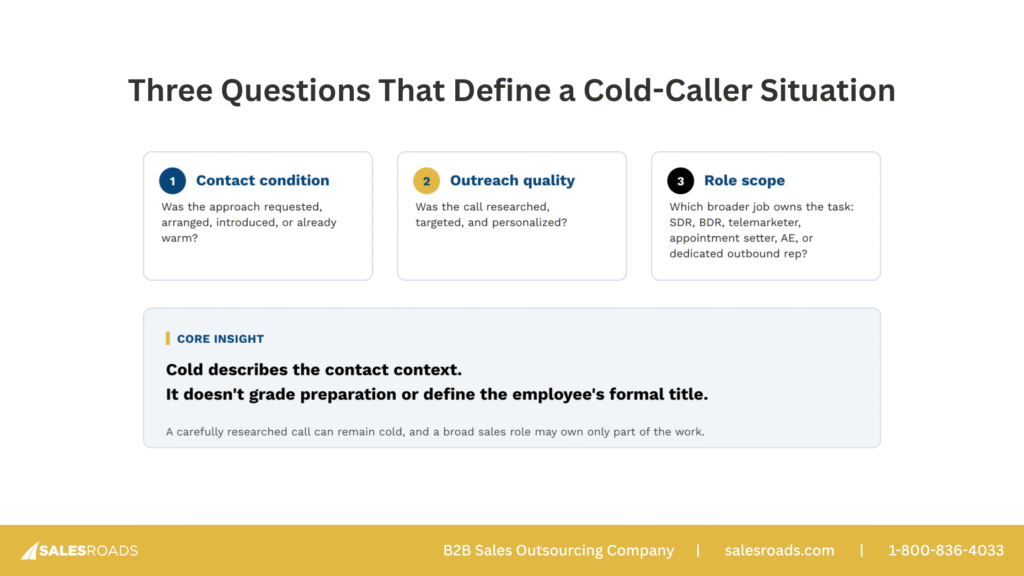
Common Misconceptions About Cold Calls
A seller’s effort doesn’t equate to a buyer’s interest. Designating a call as hot or cold only describes the contact; extrapolating temperature to indicate interest, revenue potential, or any other intent signal can lead to a costly mistake.
1. Preparation doesn’t make a call warm
Even if a salesperson thoroughly researches an account, identifies the perfect decision-maker, and crafts a highly personalized opening, that only better prepares them for the call. It vastly improves the quality of the conversation, but the call remains nevertheless cold because the prospect didn’t ask for it.
2. Brand awareness isn’t equal to an invitation
While a buyer might recognize your company’s name from an advertisement, trade show, or piece of content, that passive awareness doesn’t automatically create a sales relationship. Unless there’s been a mutual introduction or a direct request, that first call is still cold.
When Does a Call Become Warm?
A call becomes warm when the buyer has requested, scheduled, or actively engaged with the conversation. For instance:
- Inbound requests: If a prospect fills out a website form asking to speak with sales and a rep calls them back, the rep is making an outbound dial, but the call is warm because the buyer explicitly requested it.
- Scheduled follow-ups: If a prospect agrees to speak again next Tuesday, that call is a scheduled continuation.
- Active opportunities: When an account executive calls a prospect who’s already in the discovery phase of a deal, the ongoing sales conversation makes it warm.
The rule of thumb is, if the specific conversation has already been requested or arranged, the call is no longer cold.
What Does a Cold Caller Do?
The cold calling process starts well before the phone rings. The caller needs to know who to contact, why the conversation may matter, and what a useful next step would be. Cold calling preparation improves the call without making the contact warm.
Common responsibilities of a cold caller include:
- Prepare a focused list of target accounts and contacts.
- Review the account, buyer’s role, and relevant reason for the call.
- Make the call and open the conversation clearly.
- Ask questions to understand the buyer’s needs, timing, and fit.
- Handle early objections or route questions to the right person.
- Agree on the next step, such as a meeting or follow-up call.
- Record the outcome and useful context in the CRM.
- Follow the outreach plan when the first attempt doesn’t land.
What happens next depends on the procedural flow. In some teams, the caller checks if there’s a real fit and hands the opportunity to an account executive. The same person books the meeting, takes the order, or stays involved through discovery and closing.
The responsibilities above emphasize how highly skilled cold callers must be in starting cold conversations, handling objections, and guiding the prospect to the preferred next step.
Is Cold Caller a Job Title or a Function?
A cold caller can either be a function (task) or a job title. The scope of the role depends on the company’s organizational structure and its internal capacity. Many businesses designate it as a task within sales development, business development, telemarketing, appointment-setting, or account executive roles.
Cold Caller vs. Telemarketer, SDR, BDR, and Appointment Setter
| Label | Main job | Typical scope | How cold calling fits |
|---|---|---|---|
| Cold caller | Starts unrequested or unarranged sales calls | Narrow function or main task | Cold calling defines the label |
| Telemarketer | Sells and solicits by phone | Broad, phone-based occupation | May handle cold calls, inbound calls, and follow-up |
| SDR | Builds pipeline via research, outreach, qualification, and handoff | Broad sales development role | Cold calling may be one channel |
| BDR | Develops new business through prospecting and opportunity creation | Broad, company-defined role | May conduct cold calls as part of an outbound strategy |
| Appointment setter | Books meetings for another seller/team | Goal-specific function | Can use cold or warm outreach |
| Account executive | Owns more of the sales process, often including closing | Later-stage or full-cycle role | Not dependent on cold calling |
The table shows that, while there may be some overlap, each job title has its own scope of work. A cold caller encompasses one type of outreach, while an SDR, BDR, telemarketer, appointment setter, and account executive handle broader or different jobs. One person can hold any of those titles and still cold call when the situation calls for it.
Essential Skills and Training for Modern Cold Callers
Succeeding as a cold caller requires far more than just a willingness to dial and try to strike up a conversation. Because they’re constantly interrupting busy professionals, modern outbound specialists must combine emotional intelligence with conversational agility and technical proficiency.
Building a high-performing cold calling team or mastering the role yourself requires developing certain core skills and training.
Resilience and Emotional Detachment
In outbound sales, rejection is often the default. A cold caller will hear no, get hung up on, and face objections more often than they’ll book a meeting. Effective callers are trained to detach their personal self-worth from the outcome of the call. They view a no as data rather than a personal failure. This resilience prevents burnout and allows the caller to bring the same high level of energy and professionalism to the 50th dial of the day as they did to the first. As David Kreiger put it, “Celebrate those rejections – they’re a part of the sales journey.”
Vocal Tone and Delivery
People decide whether they trust a stranger on the phone within the first few seconds, and it’s based almost entirely on how the person sounds, according to the University of Glasgow and Université Aix-Marseille. Effective cold callers must master their tone, pacing, and volume to avoid an overly enthusiastic, salesy pitch voice. They’re trained to speak with calm authority, use strategic pauses to avoid sounding rushed, and naturally match the energy and pace of the prospect on the other end of the line.
Active Listening
While a cold caller might start with a script or a framework, reading text like a robot guarantees failure. A skilled caller must quickly earn the right to the prospect’s time and then seamlessly manage the flow of the conversation. That requires intense active listening. Instead of waiting for their turn to pitch, effective callers listen for specific problems and pivot their messaging to stay relevant. They’re trained to acknowledge the lead’s concerns, reframe the conversation around the buyer’s needs, and gently guide them toward the next step.
Technical Proficiency and the Tech Stack
Today’s cold callers skip the physical phone book. They instead operate a sophisticated tech stack designed for high-volume efficiency and precision. To be effective, a caller must be trained to use:
- Customer Relationship Management (CRM) software: Tools like Salesforce or HubSpot to log call notes, update prospect statuses, and maintain a clean database.
- Sales Engagement Platforms: Cold callers use these tools to organize daily tasks, sequence follow-ups, and track engagement metrics.
- Dialing Technology: Power or parallel dialers that automate the physical act of calling, drop pre-recorded voicemails, and route live connections instantly.
- Prospecting and Data Tools: Platforms like ZoomInfo or LinkedIn Sales Navigator to quickly verify a prospect’s role and contact information.
Because both buyer behavior and software change rapidly, the best cold callers never stop training. Routine role-playing, call-coaching sessions, and reviewing call recordings are essential to keeping their skills sharp and their messaging relevant.
Is Cold Calling Legal?
Cold calling is generally legal, but compliance depends on who you’re calling, what you’re selling, and the technology you use to make the dial.
The FTC’s Telemarketing Sales Rule (TSR) treats B2B cold calls differently from consumer telemarketing. Most B2B calls under this regulation are exempt from strict consumer protections, meaning B2B callers typically don’t need to scrub their lists against the National Do Not Call Registry.
However, that exemption has limits. For example, B2B calls are fully subject to FTC restrictions if you sell non-durable office or cleaning supplies, or if the call involves deceptive practices, credit card laundering, or certain business opportunity schemes.
Relatedly, the FCC enforces the Telephone Consumer Protection Act (TCPA), which applies strict rules based on exactly how a call is made, including:
- Dialing technology: Using automatic telephone dialing systems (auto-dialers) requires prior consent, particularly when dialing cell phones.
- Prerecorded messages: Leaving artificial or prerecorded voice messages (i.e., robocalls) is prohibited without explicit, written permission.
- Device types: Calling a mobile device carries much stricter consent requirements and penalties than calling a traditional business landline.
So, while cold calling is a standard business practice, the cold label doesn’t guarantee legality. Always review current federal and state regulations and consult qualified legal counsel before launching an outbound campaign
When Dedicated Cold Calling Makes Sense
A dedicated cold-calling function makes sense when the work is too important or demanding to remain an occasional task. It creates one owner for targeting, preparation, daily activity, coaching, qualification, follow-up, and reporting for a successful outbound sales program.
A dedicated cold calling role is most useful when:
- Account executives need to protect time for discovery, proposals, and closing.
- Prospecting volume requires a steady daily rhythm.
- Data, targeting, messaging, and coaching need one clear owner.
- Qualifications and handoff rules are inconsistent across the team.
- Managers need clearer reporting on activity, conversations, meetings, and learning.
The right model depends on volume, market complexity, and management capacity. A complex market may benefit from a specialist who can learn the buyer’s language and improve through focused coaching. A smaller team, meanwhile, might keep cold calling inside an SDR or full-cycle role. Teams that need a full system should explore appointment-setting services or outsourced SDR services.
Recommended listen: Predictable Revenue in Unpredictable Times with Aaron Ross
This episode of the “Sell Like a Leader” podcast explains why specialization still matters and why leaders should define the work before deciding which people or tools should own it. That idea helps leaders decide whether cold calling should remain one task inside a broad role or become a dedicated function.
The Bottom Line
At its core, a cold caller is someone who initiates an unarranged sales conversation. The depth of a seller’s research or an overall sales strategy are connected to the activity but have their own considerations. Clarify this role within your organization by outlining its parameters: Decide what “cold” means (e.g., did the buyer request the contact), how thoroughly outreach is prepared and executed, and which specific role owns the process from start to finish.
If you discover your team lacks the dedicated time for consistent outbound prospecting, rigorous qualification, and high-volume appointment-setting, you may need to bring in specialists.
Request a quote from SalesRoads today to learn how expert professionals can seamlessly take ownership of this work and build the pipeline your internal sales team needs to thrive.
Frequently Asked Questions
What is the difference between a cold caller and cold calling?
A cold caller is the person, while cold calling is the activity. The same employee may reach out to leads using cold calling, research accounts, follow up with engaged prospects, qualify inbound interest, and support later-stage sales work. A cold caller can also be one responsibility in a much larger role.
Is a cold caller the same as a telemarketer?
The terms overlap, but they’re not identical. A cold caller makes cold calls, whereas a telemarketer can do that and may also handle inbound responses, follow-ups, appointment scheduling, and direct orders. The job description shows the actual scope. Many times, cold calling is just one facet of a person’s overarching role.
What is the difference between a cold caller and an SDR?
A cold caller is someone who performs the cold calling activity in sales. An SDR encompasses a broader role that may include research, multichannel outreach, inbound lead response, qualification, meeting booking, CRM work, and handoff. An SDR can cold call without being limited to it, similar to a telemarketer.
Can a personalized call still be a cold call?
Yes. While personalization makes your outreach far more relevant and engaging, the call remains fundamentally cold if the buyer did not request or schedule it. Thorough preparation and account research will significantly improve the quality of your conversation and boost your success rate, but they do not change the uninvited nature of how the interaction began.
Is every outbound call a cold call?
No. Outbound just means the representative initiated the call, while “cold” deals with the prospect’s relationship with the company. An inquiry response, a scheduled follow-up, or a call to an engaged opportunity can be outbound and warm. Cold describes a lead’s prior invitation or level of engagement, namely, that there wasn’t any. Outbound describes direction.