Relying on one contact to shepherd your deal through worked when buying decisions were simpler. But that playbook is dead.
Today’s B2B landscape has changed, and if you’re still banking on one champion to close your deal, you’re playing a losing game.
Why Single-Threading Is No Longer Sustainable in B2B Sales
The numbers tell the story.
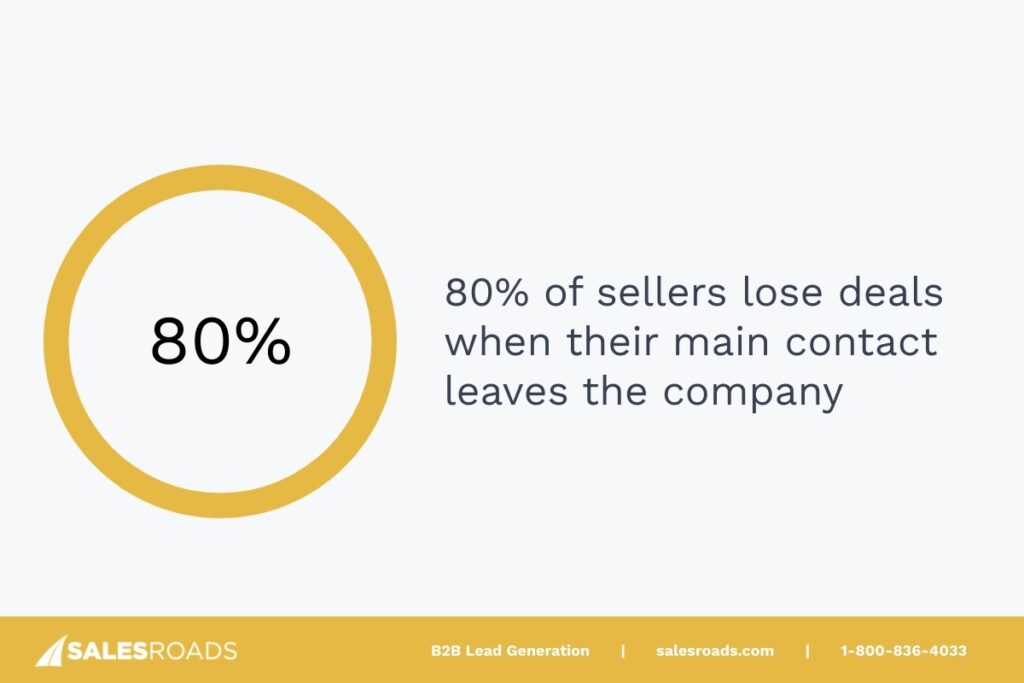
More than 80% of sellers say they’ve lost deals or seen them stall because their key contact left the company.
When you put all your eggs in one basket, you’re one resignation letter away from watching months of work evaporate.
The Risks of Relying on One Contact in a Complex Deal
Here’s what happens when you single-thread: your champion goes dark, gets promoted, leaves the company, or simply loses political capital internally. Your deal stalls. You’re back to square one, scrambling to rebuild relationships while your competitor moves ahead.
The risk isn’t just about turnover. Even when your champion stays put, you’re getting only one perspective on the organization’s needs.
You’re blind to the objections brewing in finance, the concerns simmering in IT, or the competing priorities in operations. By the time these surface, it’s often too late to address them effectively.
Single-threading also makes you vulnerable to changes in your own organization.
Sales rep turnover averages 34.7% annually, and the average tenure is just 1.5 years. If your relationship with a strategic account depends on one sales rep, you’re creating a single point of failure on both sides of the table.
How Buying Committees Are Reshaping the Sales Cycle
The average B2B deal now involves 10-11 stakeholders, and in enterprise deals, that number climbs to 15 or more.
But buying committees aren’t just larger, they’re more complex. These groups include operational leaders, managers, C-suite executives, technical experts, and end users, each with different priorities and pain points.
According to recent data, 52% of buying committees now include VP-level or higher executives, and the CFO is involved in 79% of purchases.
The buying process itself has become nonlinear. Buyers loop back through sales stages multiple times before making a decision.
This complexity has real consequences. The more people involved, the harder it becomes to achieve consensus unless you’re actively building alignment across the entire committee.
What Multi-Threading Really Means in B2B Sales Strategy
Multi-threading is building relationships with multiple stakeholders within a target account, not just finding more contacts, but creating a network of champions who can advocate for your solution from different angles within the organization.
When you’re connected to multiple decision-makers and influencers, you’re no longer dependent on a single person’s tenure or internal credibility.
You have multiple threads pulling your deal forward simultaneously.
Definition and Key Elements of a Multi-Threading B2B Approach
At its core, multi-threading means engaging 3-5 or more stakeholders per account in a coordinated, strategic way. But it’s not about blasting generic messages to everyone with a relevant title.
Effective multi-threading requires:
- Strategic stakeholder mapping: Identify who holds budget authority, who drives technical validation, who controls internal politics, and who are your potential champions and blockers.
- Personalized engagement: Each stakeholder needs messaging tailored to their priorities. The CFO cares about ROI and cost containment. The VP of Operations wants operational efficiency. The IT director needs security and integration assurances.
- Coordinated orchestration: Your touchpoints across stakeholders need to tell a consistent story while addressing individual concerns.
The Shift from Transactional to Relationship-Based Sales
Multi-threading represents a fundamental shift in how we approach B2B sales. The old transactional model—find the decision-maker, make the pitch, close the deal—assumes buying decisions happen in isolation.
That model never fully reflected reality, but it’s completely obsolete now.
Relationship-based selling acknowledges that B2B purchases are organizational decisions, not individual ones. Deals get done when multiple stakeholders align around a shared understanding of the problem and the solution.
Your job isn’t to convince one person; it’s to facilitate alignment across a group.
This shift changes everything about how you sell. Instead of rushing to close with your champion, you invest time mapping the broader organization.
Instead of pitching features, you’re diagnosing organizational challenges and building consensus around how to solve them. Instead of managing a linear sales process, you’re orchestrating a complex network of relationships.
Who’s in the Room? Mapping the Modern Buying Committee
Understanding who sits on the buying committee is the foundation of effective multi-threading. But here’s the reality:
There’s no standard template. Committee composition varies by company size, industry, and deal size. However, certain archetypes appear consistently across B2B purchases.
Key Roles and Decision-Making Dynamics You Need to Know
| Title | Role |
| The Economic Buyer | This person controls the budget and has final sign-off authority. They care about strategic value, ROI, and alignment with business priorities. |
| The Technical Buyer | Usually from IT, engineering, or operations, this stakeholder validates whether your solution actually works. They dig into integration requirements, security protocols, scalability, and technical specs. |
| The Champion | Your internal advocate who believes in your solution and actively sells it for you. Champions emerge from various roles. The key is they have credibility and motivation to push your deal forward. |
| The Influencer | Someone without final decision authority but whose opinion carries weight. They shape how others think about the problem and evaluate options. |
| The Blocker | Every committee has potential blockers. Sometimes they’re visible; sometimes they’re lurking in the background until late in the process. Identifying and addressing blockers early is critical. |
The power dynamics matter as much as the roles. Authority is decentralized in complex B2B sales. Budget holders, technical validators, and political influencers often sit in different parts of the organization.
Tips for Effective Buying Committee Management
In the Sell Like A Leader podcast, David Kreiger welcomed Mark Hunter to talk about multithreading. Mark shared multithreading and relationship-building strategies for sales teams to create value through internally and externally.
You can give it a listen here:
Here are some tips for buying committee management:
- Don’t wait until late in the sales cycle to understand the committee structure. Look for recent organizational changes, new hires in relevant roles, and people who’ve posted about relevant business challenges.
- Not every friendly contact is an effective champion. Ask yourself: Do they have the credibility to influence others? Do they understand the political landscape? Are they willing to actively advocate for you in internal discussions? If not, keep building your network.
- Your champions need ammunition to sell internally. Give them case studies, ROI analyses, technical documentation, comparison matrices—whatever they need to make your case when you’re not in the room.
- Connect with both tactical users and strategic executives. Ground-level users provide insight into operational challenges and implementation concerns. Executives focus on business outcomes and strategic fit. You need both perspectives.
- When you’re engaging 5, 8, or 11 people, consistency becomes critical. Everyone on your sales team needs to reinforce the same value proposition and business case. Mixed messages kill deals in multi-threaded environments.
- Different stakeholders prefer different communication channels. Some respond to email, others to LinkedIn, some prefer phone calls or video meetings. Don’t rely on a single channel; implement multichannel outreach.
- Multi-threading protects you from turnover, but only if you maintain current relationships. When someone leaves, you should have at least two other contacts who can step up.
- With multiple stakeholders and touchpoints, things get complex fast. Use your CRM to track relationships, note key concerns by stakeholder, document internal dynamics, and ensure your entire team has visibility into the account structure.
- Look for opportunities to bring stakeholders together—joint meetings, workshops, demonstrations, business reviews. These moments accelerate alignment and give you real-time insight into group dynamics.
- Different stakeholders will have different concerns. Anticipate these objections and address them directly with each stakeholder before they become deal-killers.
Common Pitfalls in Multi-Threading (and How to Avoid Them)
Multi-threading sounds simple, right? Not quite.
Without a strategy, you risk spreading yourself too thin, diluting your message, and confusing stakeholders. Internal misalignment between account owners and sales reps can also undermine your efforts, leaving gaps in coverage or inconsistent messaging.
To succeed, teams must prioritize high-impact stakeholders, maintain alignment, and coordinate messaging across every thread. Doing so ensures that multi-threading strengthens your deals rather than adding complexity that slows them down.
Spreading Too Thin vs. Strategic Engagement
One common mistake is trying to reach everyone in the organization, and doing so superficially. That leads to diluted messaging, weak relationships, and wasted effort.
To avoid this:
- Prioritize where to thread based on influence and decision power. Use a stakeholder map to rank by role, influence, and mission-criticality.
- Focus on 3–5 high-impact stakeholders rather than casting a wide net. That gives you meaningful relationships without burning out your reps or confusing your message.
- Use account-based content that’s tailored so each outreach has real value for the person you’re engaging.
Internal Misalignment Between Sales Reps and Account Owners
Multi-threading only works if everyone on your team is on the same page.
Here’s where misalignment often kills deals:
Sales reps may assume the champion “owns” opening the account, but without coordination, different team members might reach out with conflicting messages.
Without a shared view of the stakeholder map, some reps could neglect key decision-makers or over-invest in lower-impact roles.
To avoid this:
- Build a shared stakeholder plan (in your CRM or sales playbook) so account owners and reps align on who to engage, when, and how.
- Run regular alignment meetings: review who has been engaged, what obstacles remain, and whose support you still need.
- Use shared enablement tools: provide standardized decks, hub of content, talking points — so every rep and account owner speaks with consistency.
Bottom Line
Multi-threading isn’t optional.
Stop relying on a single champion to carry your deals. Map the stakeholders, tailor your messaging, and build relationships across the organization.
When you make multi-threading part of your rhythm, you don’t just protect your deals from risk; you unlock faster alignment, higher win rates, and deeper, longer-lasting customer partnerships.
Start threading your accounts today, or risk watching opportunities slip through cracks you didn’t even know existed.