Account-based marketing works.
The data is clear on that point. In fact, 87% of B2B marketers say ABM initiatives outperform other investments in terms of ROI.
But here’s what the success stories don’t always mention:
Scaling ABM is hard.
When you’re targeting 50 accounts, personalization is manageable. Your team knows each account intimately. They craft custom content, coordinate with sales, and track engagement manually.
When you want to target 500 accounts? Or 5,000?
Everything breaks.
The playbooks that worked at a small scale don’t translate. Your team gets stretched thin. Quality drops. Response rates plummet. And suddenly, that impressive ROI starts looking more like wishful thinking.
Why Scaling ABM In-House Is So Difficult
Scaling ABM internally sounds like a natural next step, but in practice, it introduces operational, technical, and organizational challenges that many teams underestimate.
Here’s why building and scaling ABM in-house is often harder than expected:
The Talent Gap Is Real (and Expensive)
Finding people who truly understand ABM isn’t easy. This supply-demand mismatch drives up salaries and extends hiring timelines.
A senior ABM manager in the U.S. now commands an average salary between $136,000 and $233,000, according to Glassdoor data.

Add benefits, tools, training, and management overhead, and you’re looking at a fully-loaded cost approaching $300,000 per hire.
And one hire isn’t enough.
A robust ABM program requires specialists across multiple disciplines:
- Data analysts to identify and score accounts
- Content creators for personalized messaging
- Campaign managers to orchestrate multi-channel outreach
- SDRs trained specifically for account-based selling
- Marketing ops people to manage the tech stack
Building this team from scratch takes 6-12 months minimum. Scaling it takes even longer.
The Tech Stack Problem
The typical enterprise ABM sales tech stack includes:
- Account identification platforms
- Intent data providers
- Personalization tools
- Multi-channel orchestration platforms
- Analytics and attribution software
Companies allocate 19-20% of their marketing budgets to software and tools, and ABM requires specialized tools. Worse, these tools require expertise to use effectively.
The Coordination Nightmare
ABM is a coordinated effort between marketing, sales, customer success, and sometimes product.
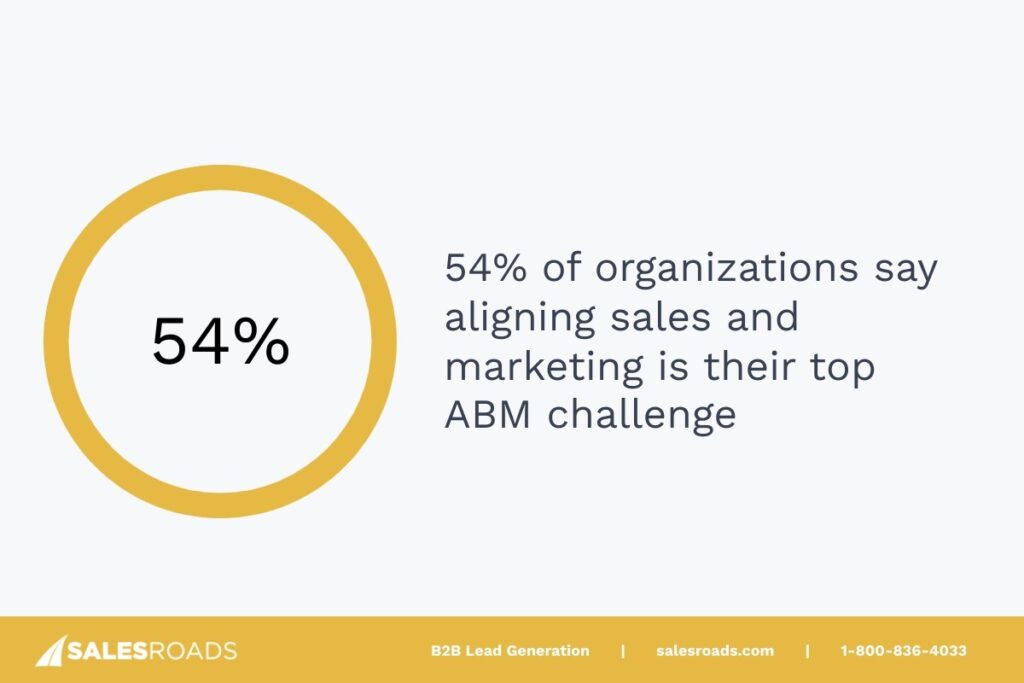
Research shows that 54% of B2B organizations cite “alignment between sales and marketing” as their biggest ABM challenge.
When you’re scaling, this alignment problem multiplies.
More accounts mean more handoffs. More handoffs mean more opportunities for miscommunication. More miscommunication means more lost deals.
Internal coordination at scale requires dedicated project management, clear processes, and constant communication. Most organizations underestimate this overhead until they’re already drowning.
The Quality vs. Quantity Trade-Off
Here’s the uncomfortable truth about scaling ABM in-house: quality almost always suffers.
Research shows that engagement drops from ~60% to ~15% when scaling personalization across a larger list. Generic “personalized” campaigns—ones that swap in a company name but change little else—perform only marginally better than traditional demand gen.
Your team can only maintain deep personalization for so many accounts. Push past that limit, and you’re doing ABM in name only.
The Case for Outsourcing ABM Campaigns
Outsourcing ABM isn’t about giving up control; it’s about removing the bottlenecks that slow teams down.
For many companies, external ABM support offers a faster, more cost-efficient path to scale.
What “Outsourcing ABM” Actually Means
Outsourcing ABM doesn’t mean handing your entire strategy to an external agency and hoping for the best.
Smart outsourcing is surgical. You identify the specific functions that are bottlenecking your growth, then partner with specialists who can handle those functions at scale.
Common functions to outsource include:
Data and Research
- Account identification and prioritization
- Contact data acquisition and enrichment
- Intent signal monitoring
- Competitive intelligence gathering
Outreach Execution
- Multi-channel campaign deployment
- Personalized email sequences
- LinkedIn outreach
- Direct mail coordination
- Phone-based engagement
Content Development
- Account-specific messaging
- Industry-vertical content
- Personalized assets (one-pagers, case studies)
Appointment Setting and Qualification
- SDR functions for account-based outreach
- Meeting scheduling with target accounts
- Initial qualification conversations
Speed to Market Matters
In ABM, timing is everything.
Your target accounts have buying windows. They’re actively researching solutions, evaluating vendors, and making decisions on their own timeline—not yours.
According to Gartner research, B2B buyers spend only 17% of their total purchase journey meeting with potential suppliers. The rest is spent researching independently, consulting with internal stakeholders, and comparing options.
If you’re building internal capacity while your competitors are already engaging your target accounts, you’ve lost ground that you may never recover.
Outsourcing lets you move fast. A good partner can have campaigns running within weeks, not quarters.
How to Build a Scalable ABM Strategy Through Outsourcing
Scaling ABM through outsourcing requires clarity, structure, and the right handoffs. The steps below outline how to build a model that grows without breaking:
Step 1: Define What You Keep In-House
Not everything should be outsourced.
Keep these functions internal:
- Brand voice and messaging framework: External partners should execute within the guidelines you set, not define your brand.
- Sales relationships: The final conversations, negotiations, and relationship-building should stay with your sales team.
- Performance analysis and optimization: You need to own the insights that drive strategic decisions.
Think of it this way: keep the brain in-house, outsource the muscles.
Step 2: Choose the Right Outsourcing Model
There are several ways to structure ABM outsourcing:
Full-Service ABM Agencies
These partners handle everything from strategy to execution. Best for companies with minimal internal ABM expertise who want a turnkey solution.
- Pros: Comprehensive, low internal management burden
- Cons: Less control, higher cost, potential misalignment with company culture
Specialized Function Partners
These providers focus on specific ABM components—data, outreach, content, or appointment setting. Best for companies that have some internal capability but need to scale specific functions.
- Pros: Targeted expertise, more control, often better unit economics
- Cons: Requires coordination across multiple partners, more internal management
Staff Augmentation
Hiring contract specialists who work as an extension of your team. Best for companies that need capacity but want to maintain full control over execution.
- Pros: Maximum control, feels like internal team
- Cons: Higher management burden, may not bring specialized ABM expertise
For most mid-market companies, the specialized function model offers the best balance of control, expertise, and scalability.
Step 3: Get Your Data Foundation Right
Every ABM program lives or dies on data quality.
Before scaling—whether internally or through outsourcing—you need:
- Clean account lists: Your target account list should be based on clear ideal customer profile criteria, not gut instinct.
- Verified contacts: Names and titles aren’t enough. You need direct phone numbers, verified email addresses, and insights into organizational structure.
- Intent signals: Understanding which accounts are actively researching solutions like yours helps prioritize outreach and personalize messaging.
Step 4: Establish Clear Handoff Processes
The biggest failure point in outsourced ABM isn’t vendor capability. It’s poor handoffs.
When an outsourced team generates a qualified meeting, what happens next? If the answer isn’t crystal clear—documented, agreed upon, and measured—you’ll lose deals in the cracks.
Define and document:
- Lead qualification criteria: What makes an account “ready” for sales engagement?
- Handoff protocols: How are meetings transferred? What information accompanies them?
- SLAs: How quickly must sales follow up? What’s expected from each party?
- Feedback loops: How does sales communicate back about lead quality?
Step 5: Measure What Matters
ABM metrics differ from traditional demand gen metrics. Make sure you’re tracking the right things:
- Account-level engagement: Are your target accounts engaging with your brand across channels?
- Pipeline velocity: How quickly are target accounts moving through your funnel compared to non-ABM accounts?
- Win rates: Are you closing ABM-targeted accounts at higher rates?
- Deal size: Are ABM accounts generating larger contracts?
- Customer lifetime value: Do ABM-acquired customers retain and expand better?
When working with outsourced partners, establish shared dashboards and regular reporting cadences. Everyone should be working from the same data.
Common Outsourcing Mistakes to Avoid
Mistake 1: Outsourcing Strategy Too Early
Some companies hand everything to an agency before they understand what works for their market.
This is backwards.
You should have a working ABM playbook—even if it’s small scale—before you outsource. You need to know what messaging resonates, which channels work, and what a qualified opportunity looks like.
That said, there is an important exception.
If you want to pursue ABM but lack deep market intelligence, outsourcing SalesRoads’ market research lead generation is a smart first step.
Instead of selling, this approach focuses on discovery. Prospects are contacted as researchers and asked structured, survey-style questions designed to uncover operational pain points, system gaps, budget cycles, renewal timelines, and upcoming initiatives.
For companies early in their ABM journey, this type of outsourced market intelligence helps build the foundation ABM actually requires before scaling execution.
Mistake 2: Choosing ABM Outsourcing Partners Based on Price Alone
The cheapest option is rarely the best option in ABM.
A partner who delivers 100 meetings at $200 each isn’t better than one who delivers 50 meetings at $300 each—if those 50 meetings close at twice the rate.
Evaluate partners on:
- Relevant industry experience
- Data quality and sources
- Integration capabilities with your tech stack
- Communication and reporting practices
- References from similar companies
Making the Decision: In-House vs. Outsource
The choice between building in-house capability and outsourcing isn’t binary. Most successful ABM programs combine both.
Consider outsourcing if:
- You need to scale quickly to capture a market window
- Your internal team is at capacity with current accounts
- You lack specialized ABM expertise in specific functions
- Your budget supports variable costs but not fixed headcount
- You want to test ABM viability before building a full team
Consider building in-house if:
- ABM is a core long-term competency you want to own completely
- You have extended timelines and a budget for team building
- Your industry requires deep specialized knowledge that’s hard to transfer
- You’ve already validated ABM and need dedicated, permanent resources
For most growing B2B companies, the optimal approach is a hybrid: maintain strategic control and sales relationships internally while partnering with specialists for data, outreach execution, and campaign scaling.
Bottom Line
The companies winning at ABM aren’t necessarily the ones with the biggest teams. They’re the ones who’ve figured out how to combine internal strategic expertise with external execution capacity.
They keep what matters close, they outsource what can be scaled, and they invest heavily in the connective tissue between the two.