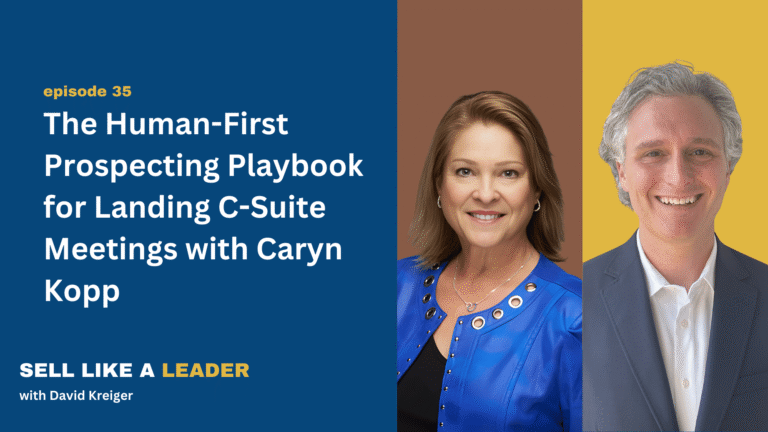
Sell Like A Leader – Episode 35
David Kreiger sits down with Caryn Kopp, Chief Door Opener at Kopp Consulting, to explore why today’s prospecting landscape is stacked against sellers, and what sales leaders need to do differently to break through.
Caryn brings a human-first philosophy to prospecting built on 27 years of opening C-suite doors, and she challenges some of the most common assumptions.
In this episode, she breaks down:
- Why executive buyers ignore outreach that “feels” AI-generated
- How precision targeting and disciplined ICP selection outperform volume
- The structural shift sales leaders must make to build a predictable pipeline
- The difference between using AI for research vs. outsourcing your thinking
- Why prospecting requires a different DNA than closing, and why most AEs shouldn’t own both
If you’re a revenue leader trying to balance AI efficiency with real pipeline results, this conversation will challenge how you think about prospecting in 2026.
About Caryn Kopp
Caryn is the Chief Door Opener® at Kopp Consulting, a 3x Inc. 5000 winner, with over 25 years in business.
She is best known for the Door Opener® Service, where senior-level business developers land executive-level prospect meetings for their clients.
Podcast Key Takeaways
- Executive buyers can sense AI-driven outreach and often reject it. If a message feels generic or auto-generated, C-suite leaders see it as a lack of effort, which creates instant disconnect.
- Prospecting and closing require different DNA. You can train skills and provide tools, but you can’t force someone to thrive in a role they’re not wired for.
- Pipeline instability is often a structural problem, not a performance problem. When closers are responsible for prospecting, the top of the funnel is the first thing to suffer.
- Time and talent aren’t enough; desire matters. If a rep doesn’t genuinely want to prospect, no amount of freed-up time or coaching will consistently produce results.
Connects
Connect with Caryn Kopp: https://www.linkedin.com/in/carynkopp/
Connect with David Kreiger: https://www.linkedin.com/in/davidkreiger
Subscribe to the podcast and follow our Podcast LinkedIn page so you don’t miss any episodes!
Transcript
David: Welcome back to another episode of the Sell Like a Leader podcast. The podcast for revenue leaders who are on a mission to cultivate a high performing sales team within their organization. I'm your host, David Krieger, founder of SalesRoads, where America's most trusted sales outsourcing and appointment setting.

Firm and today we bring you another great revenue leader, Caryn Kopp. Caryn is the chief door opener at Kopp Consulting, a three time Inc. 5,000 winner with over 25 years in business. And she is best known for the door opener service, where senior level business developers, land executive level prospect meetings for their clients.
 She's an internationally recognized speaker.

That's one of the places where I got to know Caryn. I got to hear her speak  just two months ago, giving a great presentation on how to get C-level meetings, and am so excited to welcome her to the podcast here today.

Thanks so much, Caryn.

Caryn: Well, thank you. I'm excited to be here.

David: So when we spoke earlier, you had mentioned that everyone is automating everything, making prospecting faster, but you're observing that executive buyers are actually pushing back against this. In your opinion, the human touch more than ever.

And so I would love to dive into this with you because it's a hotbed of discussion, what we automate, what we don't automate.

And so let's start with this, you believe that executive decision makers can spot AI generated outreach and you believe they actually view it as almost disrespectful. And so would love your perspective on, on why you feel that way.

Caryn: Yeah, and one of the things you said  right when you opened is making prospecting faster, but it doesn't actually make good prospecting faster. It just makes the activities go a little quicker, but it doesn't necessarily translate into the results that everybody really wants.

And so why, why is that? When when I talk to executive level decision makers, one of the things that I ask them is if somebody who didn't know you wants to have a meeting with you, what would it take?

And the first thing they come out with now, which they didn't come out with a couple of years ago, is that if I think something was generated by ai, even if it wasn't. So it's not like that, it's for sure generated by ai. They may not even know if it is, but if they think it is, they will disregard it. Why are they disregarding it?

Because they feel it's disrespectful to them. If somebody really wants a meeting with them, they have to do their research. This is what they say. The  executive level buyers are saying this, do your research. Don't tell me something that I can go find on ChatGPT myself. Say something that's really meaningful that goes three steps beyond that and provides an insight about it.You can get your research from there. But don't do your outreach from there.

The outreach needs to be much more personalized and human, and that's what they're looking for.
The sellers who are willing to invest their time to do that, not just in a sequence, but first outreach, second outreach, third outreach are going to get in faster.

They're going to get. More so than people who are just sticking something in chat, GPT, not reviewing it to see if it's actually the intended message. Is that intent still the same, and then personalizing it for the human who's going to receive it based on where they are in the process of their  relationship with that other human.

David: let me, let me dig into that a little bit. 'cause I think what you're saying is, is something I've been thinking, a lot about it. You're not saying don't use. Ai, but what you're finding is a lot of sellers are kind of taking the easy way out and they are putting something in a AI and then just copying and pasting it and, and using that either in their email or reading off of it for their script.

And the worry I have about ai, which, and tell me if this is a along the lines with what you're doing, is, is I feel like it makes it so easy to feel like you're doing something productive when. You're, you're not, and it kind of takes away our intelligence and we're, we're gifting it to, to AI where it is okay to do research.

I mean, it's an amazing research tool to find things about the client find things about the prospect. But then as a salesperson, you have to really deeply think about it and which parts are, are important, and then go down that rabbit hole and ex explore that.  Don't just. Put a prompt in, copy it and paste it, because that's gonna sound like AI.

 Use it in a way that is gonna allow you to more deeply understand the prospect, and that's.

Caryn: Yeah, I, I totally agree with that. I mean, one of the things in outreach that you really need to avoid at all costs is a disconnect. That means when the prospect hears it or the prospect reads it, he or she says, this isn't for me. Or I have no idea what this means. This is not for me at all. That's a disconnect.

And so when you put something into AI and it spits it back out, it doesn't always get it spot on, but messaging has to be spot on for the person who hears it, not the person who wrote it, not for ai, but for the person who hears it when it lands. You have to create this, this sensation for the prospect of.

I didn't think about it like that  before. You're right, I do need to have this meeting, but if what AI produced doesn't understand that, that's what you're going for in, and it has to land for an individual, not a wide set of individuals, they may cause a disconnect. And once you have a disconnect, it's almost impossible to overcome that with that individual prospect.

David: Yeah, that's interesting. And so maybe you could break it down for our, our listeners. So for, for your human first approach, what, what does that look like? What does that mean? What is the, the process or or methodology that your door openers use?

Caryn: Yeah, so if it first starts with the strategist, before it even goes to the door openers and all of our door openers are senior level business developers. To take an interview here, you have to have a minimum of 10 years experience in end-to-end business development. But most of our people have more like.

15, 20, 25 years experience in business development  with heavy emphasis on getting in the door with the C-suite and not at one of the networking events where you're over the bake ziti and you just happen to meet the person there. This is reaching out to them in their offices where they are reaching out to somebody that.

That you don't know. So what it takes is you need to find insights. It's sometimes about pain, but it's not always about pain. Sometimes it's about opportunity for this individual to have something that they didn't know was possible that was going to make their life better. That's a different kind of prompt.

Then give me a three email sequence. F that's meant for the CFO of, of a mid-market company. It's, it's very different. And so what you put into that prompt in order to get out what that insight could be is critical. And then you need the person, the strategist in our case, who's going to be able to look at that and say these three.

That's going to cause a disconnect. We're not going there. These four, now this  is spot on, but that's not where it stops. Right? Then it's put into a messaging document that, that we have that is a guide, and it's not a script because life doesn't happen according to a script. So we're giving this guide.

To a senior level person who knows what to do with it. But that person isn't just picking up the phone at that point and just making a bunch of calls. They're further personalizing that, that, that guide by doing research on the individual prospect. And they're thinking about what they're seeing too.

How is it that I, that I'm going to. Further personalize what the guide is saying with what I'm seeing in their LinkedIn profile, things that they're posting, awards they might have won in the past. And then get to a place that AI would typically not be able to get to from a human element. And that's just for the first outreach.

But then if you don't reach them and you leave a message, you're going to  call back a week later. What are you going to say then? Because you can't say the same thing. How is it that you're going to build on that relationship that's budding with this other person and you have to say things that are at an executive level, things that they can't find on their own, things that aren't in the, the, you know, the general domain.
How do you apply these insights to that person's situation without causing a disconnect?

David: Interesting. And so with that, it's you. You dropped a few things. And so since we're on the topic of ai, it sounds like parts of that, and maybe you can sort of double click on each of those, are augmented by AI. And so if you could walk us through that, the strategists sounds like they do use AI by then, they use a filter.

It sounds like maybe the door opener is part of their individual research. They might, can you walk us through through that and how that strategy, the human strategy is complimented by AI.

Caryn: Yeah. And so it goes, it actually backs up from before the messaging  because you can't know what to say unless you know who you're talking to. So it all starts with the who. And in that presentation, where we were together that day, I talked a lot about precision and discipline when it comes to selecting the who, who you're going to target.

So how do you take this wide world of prospects? And make it into a smaller world of exact right fit prospects who might be more likely to feel motivation and urgency around having a meeting and around taking next steps. Because if you can isolate who those are, you are more likely to get meetings sooner than if you're targeting wide.

This is one of the problems I see. It's actually a trick basket that many companies get in. Into because they're targeting too wide and so therefore, the number of people who are going to take a meeting are fewer, but they have to go through all of this outreach in order to isolate those people. We  prefer, and our philosophy is that if you can do the qualification in the prospect list development time period, you're calling fewer people who are spot on.

Then it's a matter of. What are you going to do to, to talk to them, to, to get them to talk to you and have them agree that this meeting is going to be the best decision they're going to make this week. That's also ai. So AI to create those, the, well, the filters are created by humans, but populating. The, the companies and the people against those filters, that's a place where we're using AI because that can happen a lot faster than our research team could assemble all of that by hand.

Five years ago, you know, seven years ago, it was all by hand and it took a lot of time. Now you can streamline that part of the process and also from the messaging insights perspective. So there, there are AI tools that you can use that will help you to glean those  insights quickly. As long as you know the kinds of prompts to put in prompt writing has changed over time, even from six months ago.

Prompt writing is Very different now in order to glean those insights on why somebody would say yes to a meeting. A lot of times when people are putting messaging together, they're trying to sell the entire service, the entire product. The entire relationship. When in this moment where you and I live.

We're trying to sell the idea of the meeting, why would that be the best decision that this executive makes? All week is to say yes to this meeting, but if your messaging falls short of that, because you didn't do your research on the insights, you didn't personalize it the way it really needed to be personalized, and then of course delivery.

Because language plus delivery equals outcome. Right? And so if you can't deliver it in a human way with tonality and authenticity, then all bets are off in your  ability to get that meeting with that individual.

David: Yeah. What we found is the best use case for AI right now is what? You were talking about, which is the targeting and the who.

Caryn: Yeah.

David: So there's been so many times where we couldn't really pull a list that was. Targeted in the way we knew it needed to be targeted. A good example is MSPs. You know, if you use most of the types of tools out there, the Zoom infos of the world, there isn't a real good select for MSPs.

And so you can get a whole bunch of technology service providers and so you now can use AI to have. Every single one of the websites of those prospects read and determine sometimes in a nuanced way, because sometimes somebody's selling phone equipment, you know, and supports phone, their phone equipment, you know, is that an MSP?

But you can now, with good prompting, you can really, it's obviously not an MSP Right.  But, but the AI can figure that out where when you give it examples. And so we feel that it's been a game changer because either. We had to have people manually doing that research or we're wasting SDR time calling non-fit prospects.

And the same is true of the targets and the titles. a lot of times in, in those databases, they're not. Great. But it would be, we have two AIs on every, at a minimum, on every single program. One AI that is running on companies and making sure we've got the right ICP and one that is running off of those prospects.

And I think it's a game changer for prospecting.

Caryn: Yeah, no question. And then the question is, how often are SDRs in a typical company using this? Are they familiar with how to use this in? In our company, we're separating the outreach, which is done by the senior level door openers from the research. And a company like yours, you're probably  doing the same thing in a company that's.

Doing it on their own. Probably not. It's probably the person doing the outreach who's also assembling the prospect list. Those workflows are very different, and so when our, our door openers are doing the outreach, we want heads down with the, the people who are masterful at the outreach part. We don't want them looking up an email address.

We don't wanna slow down that workflow to look up a phone number. Or make sure the prospect is, is the exact right prospect. So those things are really important too, is to separate that workflow and then for anything that that can be done well with AI to streamline the time it takes to assemble.

Whatever it is you're assembling that, that's a critical component. But if it's not done well, then you know, and every single one of them has to be checked. Like when we use AI to assemble a prospect list with all of these different filters, a human is going through them. Every  single one. Because what we don't want is even if 5% of that list doesn't deserve to be on the list, the door opener still working, that what a waste.

We would rather have somebody in our research team going prospect by prospect through that and making sure that they deserve to be on that list.

David: I think the new models have really... I even with uh, GPT-4, it wasn't doing it all that well, but GPT five two, like it's really, um, and we can do five five Mini as actually working pretty well. So what, what I'd love to shift a little bit to is sort of the ramifications on structure in a sales organization because of AI.

Because I think a lot of companies have thought, now with ai, I can have my AEs, my salespeople do more prospecting because they can be more efficient, they can, can do more. I know you. I think at least slightly, if not adamantly disagree with this,  this concept, and I'd love you to just unpack that and give us your, your thoughts on that type of mentality that is becoming more pervasive in the industry.

Caryn: Well, I think my perspective on that is for anybody including a salesperson who's tasked with the responsibility of prospecting, if they don't really wanna do this, it's torture. It's just torture. So yes, with AI you could free up some of their time to do prospecting, but the real question is do they have the DNA to do the prospecting and and do they want to.

So when we look at this, we're, we have a formula of TTD time, talent, and desire. So somebody may have the time to do it and AI could free up more of their time to do it. But do they have the talent? We can train somebody's sales team to be better than they are with tactics and all  of that, and motivation and, and rah rah.

But I can't train somebody to have different DNA to love this part of sales. And then the desire piece is to actually spend their time doing this two hours, three hours in the chair because they love it. As opposed to they have to do it because someone told them that they're responsible for 20 calls.

That's a different, that's a whole different ball game, and AI has nothing to do with that.

David: Yeah, I think desire is the big key component that a lot of these CROs are, are kind of forgetting about. And, and there's a little more to that too, which we'll, we'll, we'll chat about. But I think just to first agree, agree with that. Prospecting is is tough. It takes a certain type of willpower, certain type of of person to really excel and love the hunt.

And if you don't love it, can you push yourself for a period of time to do it?  Maybe, and for some yes, but it's only a certain period of time. And if there are other things that you can do that feel productive, you're always gonna choose those. And so how the big part of the SDR work and the work we do for our clients is it's so important to have a predictable pipeline, um, that leads to predictable revenue.

 and. So if you're just going back and forth and you don't, can't count on somebody doing x number of dials, having x number of conversations, creating this number of meetings for themselves, that all breaks down. And especially for technology companies, but companies in general who are trying to predict what their sales are gonna be.

The math just stops math if you don't have somebody who is, is doing that. So I do think that desire is one of the, the key under underlooked things, and you're not gonna do it as well if you don't have that, that part, of, of the, the three components that you, you outline, which, which I think is great.

Caryn: Right.

David: I think for CROs and VPs of sales is, is prospecting the highest and best use of your AEs time?
And if they're really good at putting things through pipe from, from from discovery to close. Don't you want them doing more of that?

Caryn: Yeah. Well, I mean, the reality is even if they're good at prospecting, they're going to fill their pipeline with opportunities to close. And if they're commission based in any way, shape, or form, they're encouraged to work on the close. Exclusively so to the detriment of the top of the funnel for sales opportunities.

And so what that creates is these peaks and valleys in revenue creation that drive  leadership nuts, right? They, how, how can they live with that? The, the forecasting goes. Goes kablooey, and they, they can't count on anything. And then they're saying to somebody who's closing $3 million in sales? Hey, where are the next, where's the next pipeline?

But they don't worry about that because they're, they're focused on this until their pipeline is empty, and that's why. What you do and what we do is so critical, even for, for sales organizations, if they have people who are good at this, because their time is going to be consumed with closing, who's keeping an eye on the top of the sales funnel, making sure that it's constantly full of right fit opportunities.

And that's why this is such a wonderful ballet dance, right, of serving up the right sales opportunities to people who really know what to do with them. If you have those people on the team. But there are a lot of sales leaders who are stuck in, in the old belief that it has to be done  by just one person, no matter the efficiencies that have been documented and proven as long as this part of the process is being done well.

And it's being done by somebody who loves this job. The thing is that it's really hard to find somebody who loves this job. These are unicorns. Your company is a company of unicorns. My company is a company of unicorns. It's very difficult, but this is in the hiring process. You have to hire this right Unicorn.

Like when I was doing this, I mean, this is our 27th year in business. I was our first door opener. It is by far my favorite thing to do and I don't get to do it anymore because somebody told me I have to run the company now.

But I love that. And it was never really hard work. I wouldn't say it was, it was hard.

It was not just fun, but you know, I would open up what it was in those days, binders, or, you know, my Excel spreadsheet  or something before the CRMs were around, and I would say, what are all my little friends doing today? I haven't spoken with this one in a week or so. What is it that I could say this time that'll move the needle?

It's not that they have objections, they just don't understand yet. As long as they're the exact right person. It's really just a matter of time and it's a matter of figuring out how to get to them in a meaningful way. And it's okay if it's not going to happen today. I would rather have a couple more touch points with somebody before they say yes, because that makes a better meeting even though.

From the CROs standpoint, when they're looking at somebody's uh, activity, they may not wanna see that, but that is the right way to do it.

David: I love that. And, and what I'd love for you to do, because I think you, you eloquently, uh, you know, talked about the mindset of the, the door opener, the SDR, the, the, the  prospector. As we go to start wrapping up this, this session, I would love for you to. Address the sales leaders that do listen to this podcast, and if there's one mindset shift that you would love those sales leaders to walk away from today, what would that be?

Caryn: Just one. I only get one.

David: You could choose, you could have, have more now, but what, what, what would you like to say to 'em?

Caryn: I think I'll go with two and I may end up throwing in a third as a bonus, but the, the first one is try not to be stuck in the mindset that sales open through close must be done by one person. Try not to be stuck with that because right now things really need to be done differently, differently than the prospecting has changed in the last six months.

It's changed in the last two years. It's changed in the last five years, so. It's okay to think differently about this in order to  get next level results. Most of the people I'm talking to today want next level results. They found last year to be quite challenging. The cheese has moved. They're not exactly sure where the cheese is right now, so you may need some expert help figuring that out.

Your recipe has changed. So if that one person is struggling to figure it out, get some outside expert help to help you figure this out. From my perspective, and probably yours too, the best way to figure this out is by doing it, right?

So if you are a CRO who hasn't done prospecting in five years, 10 years, it's changed.
It is okay to go get some expert help to help the people on your team who are struggling. You may not know what the answers are because you haven't done this recently.

David: That's well said. Well, as we move to the end of the episode, what I'd love to ask our, our guests is just a few rapid  fire questions. Um, so Caryn, are you ready?

Caryn: Ready.

David: All right. What is the one thing people don't give enough value or attention to in leadership?

Caryn: Oh, there's Sales Pipeline. It's, it's one of your most valuable company assets.

David: Awesome. What is one skill you advise everyone in sales to master leaders or non-leader?

Caryn: Date and time, date and time, date and time, there is always a date and time for the next step in every part of the sales process. It is the single easiest way to shorten your sales cycle.

David: Love it. Favorite business leadership or sales book?

Caryn: Um, getting naked by Pat Lencioni. Because it really helps you to be just transparent with delivering, uh, information to your clients that they may not be ready to hear. And I always say to people, when I recommend this book, it's not what you think it's about.

David: I favorite quote, mantra, or saying that inspires you as a sales leader.

Caryn:  Just do it.

David: And what's the most important goal or a project you're working on right now, Caryn?

Caryn: It is what we talked about today. What, what is it that we can do to take any non outreach task time off the plate of the door opener so they can focus on human outreach. 'cause that's what's working.

David: Awesome. Well, thank you so much Caryn, uh, for coming on the podcast and sharing your experience.

You're 27 years of experience and knowledge with, uh, with us today. And if people wanna learn more about Kopp Consulting or connect with you, Caryn, how can they do that?

Caryn: Yeah, they can go to our website, it's koppconsultingusa.com and fill out a form and we'll get back in touch with you and have a really great conversation.

David: Awesome. And thank you all for listening out there to another episode of the Sell Like A Leader podcast.

Don't forget to subscribe to the podcast on your platform of choice. and as always, you could always. Look me up on LinkedIn, send me a, a message. Love to hear from you what you think about the show.
Any guests you think we should have. appreciate everyone here. Thanks again, Caryn.