Gone are the days when a generic script and a long call list could reliably fill your pipeline.
Today’s buyers expect more. They want conversations that matter, outreach that demonstrates understanding, and sales professionals who respect their time.
This guide walks you through exactly how to implement personalized sales outreach at every stage of the buyer journey, helping your team connect with prospects in ways that actually move the needle.
The Modern Buyer Has Changed So Should Your Outreach
Your prospects are drowning in outreach. The average B2B buyer receives dozens of cold calls and hundreds of emails each week. Most of them sound exactly the same.
But here’s what’s really changed.
Buyers now complete a significant portion of their research before they ever speak to a sales rep. According to Gartner, B2B buyers spend only 17% of their total purchase journey meeting with potential suppliers. That means by the time you get someone on the phone, they’ve already formed opinions and done their homework.
Jake Dunlap on the Sell Like a Leader podcast reinforces this shift, noting that many buyers are now “vetted” or “educated” before they even reach you.
He explains that treating every buyer like they are at step one of a conveyor belt is a recipe for failure. Instead, sales professionals must recognize that buyers may have already done deep research using tools like ChatGPT and are looking for specific, high-level value rather than basic education:
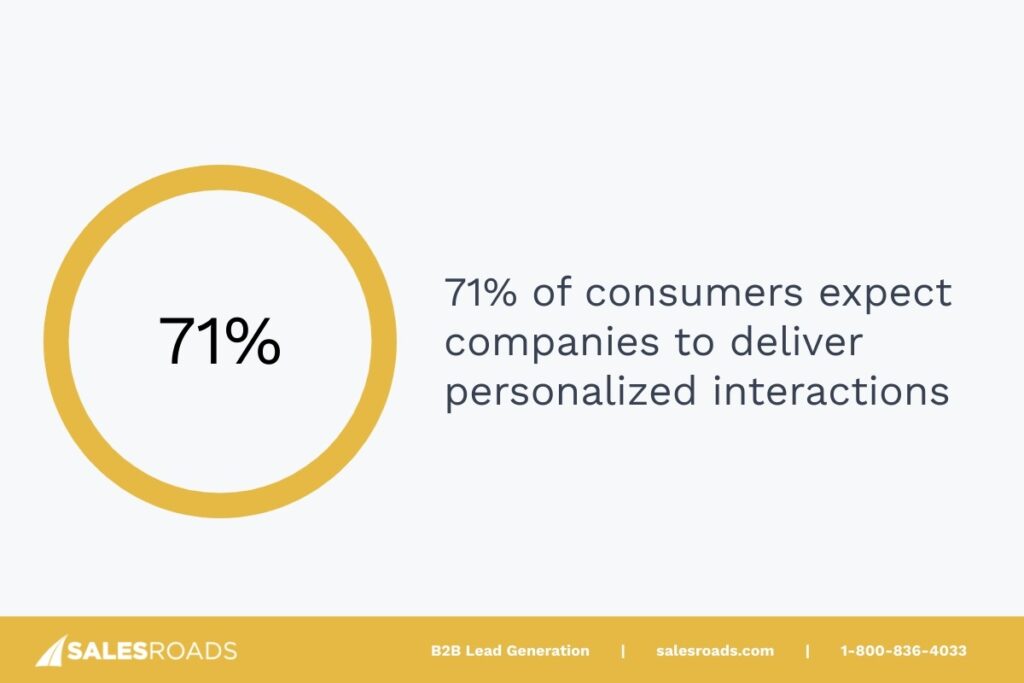
In fact, research from McKinsey shows that 71% of consumers expect companies to deliver personalized interactions. And when that expectation isn’t met, 76% get frustrated.
Think of it this way: every generic touchpoint adds friction. Every personalized one removes it.
Map Your Buyer Journey Before You Personalize
You can’t personalize effectively if you don’t know where your prospect stands. Before crafting any outreach, you need a clear map of your buyer’s journey.
Identifying Stages: Awareness, Consideration, Decision
Most B2B buying journeys follow three broad stages:
Awareness Stage
The prospect recognizes they have a problem but hasn’t started evaluating solutions. They might be experiencing symptoms—slow growth, missed targets, operational inefficiencies—but haven’t connected these to a specific need.
To truly succeed at this stage, you may need to rethink the “discovery call” entirely.
Lee Salz on the Sell Like a Leader podcast argues that the traditional discovery meeting must die because it often serves only the seller. Instead, he advocates for treating the first interaction as a “consultation.”
Just as a doctor provides value during a diagnosis, your outreach and initial meeting must leave the prospect wiser about their industry or challenges than they were before they spoke with you:
Consideration Stage
Now they’re actively researching options. They’re comparing approaches, evaluating vendors, and building internal consensus. The problem is defined; they’re seeking the right solution.
Decision Stage
The shortlist is set. They’re ready to commit but need validation—proof that your solution will deliver, that implementation will be smooth, and that they’re making the right choice.
Aligning Messaging to Each Stage
Here’s how sales personalization shifts across stages:
| Stage | Primary Goal | Messaging Focus |
| Awareness | Earn the right to a conversation | Industry insights, emerging challenges, thought leadership |
| Consideration | Establish credibility as a solution | Relevant case studies, differentiation, expertise proof points |
| Decision | Remove final barriers | Implementation details, ROI specifics, risk mitigation |
Using decision-stage language with awareness-stage prospects. If someone hasn’t acknowledged they have a problem worth solving, jumping straight to “let me show you our pricing” creates an immediate disconnect.
Your SDRs need to diagnose the stage before they prescribe the message.
Segment Your Audience With Precision
Not all prospects are created equal. Effective personalized outreach starts with smart segmentation.
Segmentation means grouping prospects by shared characteristics that influence how they buy. Common approaches include firmographic, behavioral, and needs-based segmentations.
A mid-market healthcare company evaluating their first outsourced sales solution needs a completely different conversation than an enterprise tech firm looking to switch providers.
Your CRM is the engine that makes segmentation actionable. But only if it’s properly configured and consistently updated.
In fact, according to Salesforce research, high-performing sales teams are 2.4x more likely to rate their data accuracy as outstanding compared to underperformers.
When your SDR opens a contact record, they should instantly see everything needed to personalize: industry context, previous conversations, known pain points, and engagement history.
Extracting Actionable Buyer Insights
The best sales personalization comes from multiple data sources:
Behavioral Data
Track what prospects actually do, not just what they say.
Website visits, email opens, content downloads—these signals reveal interest and intent. When someone visits your pricing page three times in a week, that’s a different conversation than a cold prospect.
CRM Triggers
Set up alerts for meaningful events:
- Job changes (new decision-makers often mean new opportunities)
- Funding announcements (budget becomes available)
- Company expansions (growth creates pain points)
- Contract renewal windows (if you’re tracking competitive displacement)
Social and News Monitoring
LinkedIn activity, company press releases, and industry news provide timely personalization hooks. Congratulating a prospect on a recent achievement or referencing a challenge mentioned in their company blog demonstrates genuine attention.
Build Messaging That Speaks to Pain Points and Stage
Now let’s turn insight into impact.
Your messaging needs to match both the prospect’s situation and their position in the buyer journey.
Early Funnel (Awareness Stage) Messaging
Focus on education and perspective. Your goal is to help prospects see their situation more clearly even before you mention your solution.
Example opener:
“I’ve been talking with a lot of [industry] leaders lately, and there’s a pattern emerging around [specific challenge]. Curious if you’re seeing the same thing on your end?”
This approach positions your SDR as an informed peer, not a pushy salesperson. You’re offering insight first, not asking for a meeting.
Mid Funnel (Consideration Stage) Messaging
Now you can be more direct about capabilities. Prospects at this stage want to understand how you’re different and whether you can deliver results.
Example opener:
“I noticed [company] is expanding your presence in [market]. When we worked with [similar company], they faced [specific challenge] during their expansion. I’d love to share what worked for them—would a brief call this week make sense?”
The key? Specificity. Vague claims fall flat; concrete relevance cuts through.
Late Funnel (Decision Stage) Messaging
Remove doubt. Address objections before they’re raised. Provide proof points and facilitate consensus-building within their buying committee.
Example opener:
“Based on our last conversation, it sounds like [specific concern] is still on your mind. I’ve put together a brief document showing exactly how we handled that for [reference customer]. Want me to send it over before your team’s meeting on Thursday?”
Train Your SDR Team to Use Personalization at Scale
Tools matter, but your team matters more.
Effective sales personalization requires ongoing training and the right balance between efficiency and authenticity.
Role-playing exercises should emphasize adapting on the fly. Give SDRs a prospect profile and have them develop personalized openers. Then change one variable and watch them adjust.
But here’s the reality: you can’t personalize every single touchpoint for every single prospect. You’d burn out your team and never hit volume goals.
The key is knowing where personalization matters most:
| Touchpoint | Automation Level | Personalization Level |
| Initial research | High (tools gather data) | Low |
| First call attempt | Low (human-led) | High |
| Follow-up emails | Medium (templates with custom fields) | Medium |
| Discovery calls | None | Maximum |
| Nurture sequences | High | Medium |
Bottom Line
Sales personalization is a mindset shift that acknowledges a fundamental truth: your prospects are real people with specific challenges, and they can tell the difference between someone reading a script and someone who genuinely wants to help.
The teams that win in today’s environment are building systems that make personalization sustainable.
Start where you are. Every improvement compounds.