- Call center appointment setting is an outbound, shared rep operating model designed to contact prospects, qualify their interest, and book meetings for a sales team.
- A shared, call center-style approach is efficient for simple offers sold into a broad total addressable market. However, if your sales motion requires deep account research, complex discovery, or tight brand control, a dedicated SDR model is the better option.
- The success of a call center appointment setting program relies on strict, repeatable processes. Before signing a contract, you must align with the provider on explicit qualification rules, CRM handoff mechanics, and how call reviews are used to fix recurring objections.
- Because high-volume models can generate a lot of activity, measuring success on booked meetings alone is dangerous. A true evaluation for call center appointment setting tracks other downstream metrics such as meetings held and revenue won.
When you’re considering hiring a call center to fill your pipeline, you need to look under the hood at the engine propelling it. In call center appointment setting, two providers can promise the exact same outcome while operating in completely different realities. One might rely on a shared calling team built for high-volume, script-based conversations. The other might assign dedicated SDRs who work across multiple channels and stay locked into a long-term feedback loop with your internal team.
In B2B, a promised appointments quota isn’t enough. You need to know the mechanics: Who’s working the account, how targets are selected, what actually qualifies as a meeting, and how calls are reviewed. Those behind-the-scenes controls determine if a partner is a good fit for your sales motion.
What Is Call Center Appointment Setting?
Call center appointment setting is an outbound, shared rep operating model designed to contact prospects, qualify their interest, and book meetings for a sales team. The reps often work from a physical call center or remotely on a shared network to dial prospects and sell a product or service.
For this guide, we strictly focus on outbound B2B programs. The definition above excludes inbound calendar scheduling, customer support or service functions, general B2C (consumer) telemarketing, and appointment setter job descriptions.
The Problem With the Label
The market uses this phrase inconsistently. Providers slap the “appointment setting” label on everything from passive inbound booking to complex outbound qualification. Even official contact center standards like ISO 18295 fail to formally define it as a distinct market category.
Because the terminology is a catchall, you have to define the service by the processes behind it. For a revenue leader, the better question to ask is, “What operating system will represent our company, qualify buyers, and hand usable context to our sales team?”
Benefits of Call Center Appointment Setting
While the right model depends on your specific sales motion, outsourcing appointment setting offers measurable advantages for B2B teams looking to scale.
Maximizes Active Selling Time
According to Salesforce, sales reps spend only 40% of their week selling. The other 60% is lost to administrative work, CRM entry, and prospecting research. A call center absorbs the heavy lifting of list-building and cold outreach, keeping your deal-closers focused entirely on revenue-generating conversations.
Reduces the Costs of Hiring SDRs
Hiring an in-house SDR involves much more than base salary. When you factor in benefits, CRM seats, data platforms, SDR management overhead, and turnover losses, a fully loaded, in-house SDR actually costs over $100,000 annually. Outsourced programs typically run at a fraction of that cost, shifting a massive fixed expense into a predictable operational investment.
Bypasses Ramp Time and Turnover
Industry reports say it takes an average in-house SDR three to six months to reach full productivity, and turnover rates for the role are dangerously close to 34%–40% annually. Outsourcing provides instant infrastructure. You bypass the months-long recruiting and ramping phases, and if a rep leaves, the agency absorbs the cost of replacing and training them.
Improving Quota Attainment
Recent benchmarking data from Ebsta and Pavilion shows up to 69% of B2B sales reps missed their quotas in recent years due to shrinking pipelines and harder-to-reach buyers. By outsourcing the top-of-funnel meeting generation, you guarantee your AEs get the leads they need to hit quota, rather than relying on them to generate their own pipeline from scratch.
Appointment Setting Models
The same appointment setting label can hide meaningful differences in staffing, research, channel use, qualification, supervision, and client involvement. Before looking at the specific controls, learn the four primary operating models you’ll encounter in the market:
1. Shared/High-Volume Call Center
A model where reps are often pooled across multiple client programs. It relies on volume calling, repeatable scripts, and list-based campaigns. It’s highly efficient for standardized products with explicit, simple qualification criteria. This is what is the quintessential call center appointment setting.
2. Specialized Appointment-Setting Agency
A middle-ground provider focused entirely on securing B2B meetings. They typically offer more customized playbooks, blend calling with email, and assist with ideal customer profile (ICP) research, although staffing allocation and depth vary widely by agency.
3. Dedicated/Fractional Outsourced SDR
A premium agency model where specific, named reps are dedicated to your account. They act as an extension of your team, conducting deeper account research, running multichannel cadences, and adapting their messaging based on direct feedback from your sellers.
4. In-House SDR
Sales development reps (SDRs) are hired, trained, and managed entirely by your internal organization. This offers maximum control, the deepest product context, and instant feedback loops but requires you to carry the full burden of hiring, tooling, QA, and management.
Compare Appointment Setting Models by Their Controls
The table below distinguishes each model based on buying archetypes. They don’t define rigid market categories.
| Dimension | Shared/High-volume call center-style | Specialized appointment-setting agency | Dedicated/Fractional outsourced SDR | In-house SDR |
|---|---|---|---|---|
| Staffing | Reps are shared across programs | Allocation varies by client and program | A dedicated rep/team | Reps employed and managed internally |
| Research and data | Repeatable lists and workflows | Adds ICP and list research | Deeper persona research | Use data and product context directly |
| Channels | Calling | Calling and other channels | Channel mix | Internally set channel mix |
| Conversation model | Repeatable tracks to support scale | Scripts and playbooks vary by complexity | More room for account context and message iteration | Highest access to internal context |
| Qualification | Works when the criteria are explicit and repeatable | Depth depends on the program | Can support more contextual qualification | Criteria can be adjusted directly with sales leadership |
| QA and coaching | Depends on monitoring, evaluation, and supervisor design | Provider-specific | Part of a managed SDR program | Requires internal management capacity |
| CRM and handoff | Must be specified in the SLA | Integration depth varies | Often built into a managed workflow | Directly controlled by the company |
| Client management burden | Lower if the program is genuinely standardized | Moderate and provider-dependent | Requires alignment on ICP, qualification, and feedback | Highest direct management burden |
When Does a Call Center Appointment Setting Model Fit?
A high-volume call center appointment setting model is the right choice when your sales motion relies on clear targeting, straightforward qualification, and repeatable conversations. If your business can tolerate standardized touch points and your internal team has the bandwidth to work on the volume of prospects produced, this is a solid option.
Before deciding though, you need to review some other considerations:
- The call center appointment setting model is a good fit for simple offers sold into a broad total addressable market (TAM). When there are plenty of targets, standardized outreach can generate a reliable pipeline.
- As your offer requires more market education, account research, or stakeholder discovery, you’ll need to give your reps more time and context for each target.
- If you have a narrow TAM, you can’t afford to burn through accounts with poor targeting. Similarly, if you have a highly brand-sensitive motion, a detached, heavily scripted conversation can do more harm than good.
A call center can book a qualified meeting, but it creates zero value if your internal seller has no calendar capacity, receives weak context, fails to follow up, or never records why the opportunity was rejected. Finding the right fit equally depends on your team’s ability to receive and execute on the call center’s output.
If you need a temporary burst of coverage, a shared call center excels at providing fast, scalable capacity. But if you want to build a long-term enterprise motion, you may value accumulated account knowledge and a stable feedback loop over immediate volume. Consider these caveats and trade-offs before committing to an initiative.
Pricing Considerations & Hidden Costs for Call Center Appointment Setting
Understanding how a provider charges is just as important as evaluating their operating model. Pricing structures typically fall into three categories, but you also need to look out for hidden fees embedded in the contract.
Pay-per-Appointment (PPA)/Pay-per-Meeting
Through this setup, you pay a fixed fee for each meeting booked, with costs varying by industry. While it may seem like the lowest-risk option, it incentivizes quantity over quality. If your qualification rules aren’t strict enough, your calendar will fill up with unqualified prospects who have no intent to buy.
Hourly or Flat Retainer
This option has you pay a flat monthly rate for a dedicated block of time and resources. It prioritizes quality, allowing reps to spend time on complex account research and multichannel touch points. It’s ideal for complex sales, but it does transfer the risk of low volume back to you.
Hybrid Model (Retainer + Performance Bonus)
This is the more common model for premium B2B agencies. A baseline monthly retainer covers the fixed costs of dedicated management, lists, and technology, while a per-meeting or per-opportunity bonus aligns the provider’s financial incentives with your pipeline goals.
Some hidden costs to consider include:
- Setup and Onboarding Fees: Most legitimate agencies charge a one-time onboarding fee to build your target lists, integrate with your CRM, write playbooks, and train the callers. Check if the cost of dialer software, intent data tools, and contact databases are included in the retainer, or if the agency will bill you separately for technology fees.
- Contract Minimums: Because outbound outreach compounds over time (due to the lists getting cleaner and the scripts sharper), most agencies require a three- to six-month minimum commitment.
How to Evaluate a Call Center Appointment Setting Provider
Once you know which operating model fits your sales motion, the next step is actually vetting agencies. But finding a reliable appointment-setting provider requires looking past their sales pitch and raw meeting guarantees. To find a true growth partner, you need to inspect their internal mechanics, align on how downstream success is measured, and ensure they meet strict legal compliance standards.
See:
Use a Control Loop to Evaluate Appointment Quality
A calling script helps a rep stay consistent, but the appointment setting operating system determines if that script actually works. Think of appointment setting as a continuous control loop:
- The target list determines who to call.
- Qualification rules dictate which conversations become meetings.
- CRM fields decide what context survives the handoff.
- QA and coaching catch and correct recurring problems.
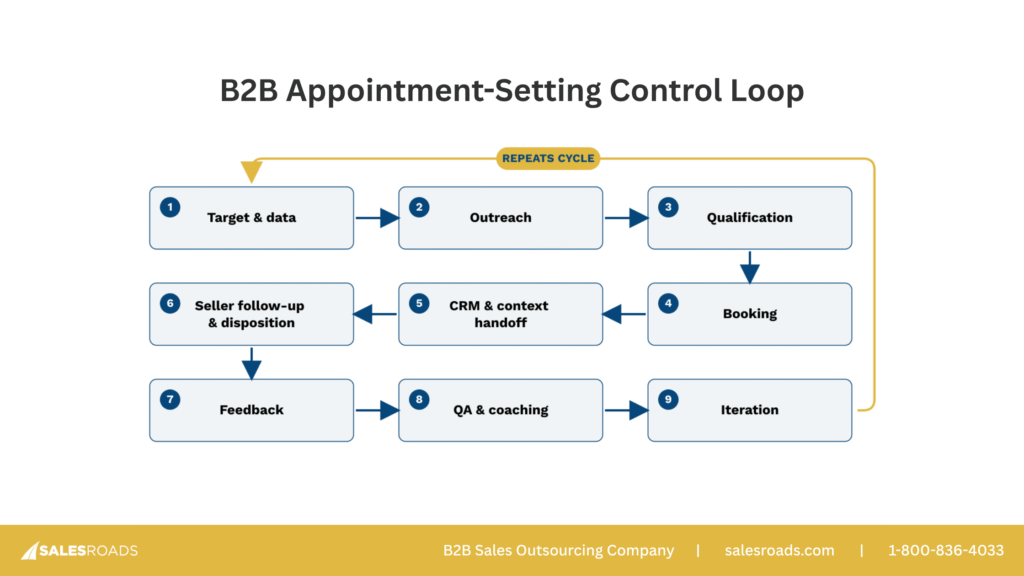
Viewing the service through this loop changes how you evaluate candidates. Instead of just checking how many dials a provider makes, you should ask, “What happens when the wrong persona keeps answering? What happens when sellers reject meetings for the same reason? How do call reviews translate into a changed list or a new coaching action?”
Measure Downstream Value
Booked meetings are a useful operational metric, but they don’t show the full value. A comprehensive measurement follows a cohort through the sales funnel, distinguishing a scheduled meeting from one that actually generates revenue. Practical, mature monitoring covers:
- Outreach attempts: The total number of individual actions taken to contact a prospect (such as calls, emails, or social messages), measured within a defined campaign and time period.
- Live contacts: The number of real-time, two-way conversations with prospects, measured as a conversion rate against total outreach attempts.
- Booked meetings: Scheduled appointments with prospects. These are counted based on strict qualification definitions locked in before the campaign begins.
- Held meetings: The number of scheduled appointments that actually took place (both parties attended), measured against the number of booked meetings for that same cohort.
- Accepted meetings: Completed meetings that the receiving sales rep officially approves, confirming that the prospect met all agreed-upon qualification criteria.
- Qualified pipeline and won revenue: The projected monetary value of active sales opportunities (pipeline) and the actual dollars captured from closed deals (revenue), attributed only after your company’s standard opportunity rules are satisfied.
- Rejection & no-show reasons: The documented explanations for why a prospect declined a conversation or failed to attend a scheduled meeting, captured in specific categories to feed back into your operating loop.
Conversion rates are only useful when the values you’re reviewing belong together. You can’t compare a show-rate for meetings booked this month against closed-won opportunities that take six months to mature.
Recommended Listen: Sell Like a Leader Episode with Mitchell Kasprzyk
In this “Sell Like a Leader” podcast conversation, Mitchell describes why blanket pipeline-coverage rules can hide meaningful differences in actual conversion behavior by seller and stage. Measurement should reflect the real path through the funnel; one activity ratio can’t describe every team. His discussion of preserving buyer context across the sales process also reinforces why the SDR-to-seller handoff belongs inside the measurement system.
Use a Buyer’s Diligence Checklist
Once you know what to measure, evaluating a provider becomes much more concrete. Craft a questionnaire that focuses on the controls that impact brand risk, data integrity, and the receiving team’s ability to use the meeting. Break your evaluation into four categories:
- Staffing and Coaching: Are reps dedicated to your account, fractional, or shared across several programs? How does the provider teach them your market, buyer roles, and brand boundaries? Who coaches them when a call review exposes a recurring problem?
- Data and Technology: Where do contact records come from? How are lists validated? What AI, dialing, or recording tools touch the campaign? What fields are connected to your CRM, and who keeps the data if the contract ends?
- Quality Assurance: How are evaluation criteria defined? A polished dashboard is useless if the provider can’t explain in detail what happens after your sales team rejects a meeting.
- The Handoff: Define exactly what background information and prospect notes the seller receives before the call, who is responsible for logging the meeting’s outcome, and how quickly a pattern of rejected meetings gets flagged to the provider for correction.
Check for Compliance
Blanket statements or ambiguous paperwork don’t guarantee federal compliance. Verify a provider’s transparency and ask what system they have in place to ensure compliance. For instance, amendments to the FTC’s Telemarketing Sales Rule expanded protections against deceptive B2B practices and updated recordkeeping requirements, mandating that covered records be retained for five years. The FCC also recently confirmed that AI-generated voices fall under TCPA rules for artificial/prerecorded voices.
To avoid flying blind, ask each provider to show exactly who owns compliance decisions, how “do not call” numbers are handled, what technology is used, and who owns the record-retention liability.
The Bottom Line: Match the Model to Your Motion
Deciding whether or not to commit to external appointment setting becomes much easier when you stop treating the label as the specification.
Define your qualification rules, handoff mechanics, and measurement standards first. Then, find the provider that matches those requirements. The right choice is the one whose operating depth matches your work. If your offer is straightforward and your targeting is broad, a call center appointment setting model is a reasonable option.
However, if your motion depends on deep account research, nuanced discovery, and a tight feedback loop for your closing team, you need a dedicated model. If your sales motion depends on this high operating depth, you’ll likely need a fully managed configuration.
We at SalesRoads built our appointment setting services around this exact requirement, pairing dedicated SDRs with the sales operations and management support necessary to run a complex, multichannel outbound motion.
Need help getting started? Talk to someone on our team today.
Frequently Asked Questions
What is the difference between cold calling and appointment setting?
Cold calling is a method of initial outreach that involves contacting prospects who have had no prior interaction with your company to introduce your brand and generate interest. Appointment setting, on the other hand, is the specific, result-oriented process of getting a qualified prospect onto a closing sales representative’s calendar. Appointment setting often happens during a cold call, but it encompasses a wider range of activities like booking meetings, making inbound inquiries, and following up on contacts.
Does searching for a local call center mean the agency must be local?
No. A geographic modifier (like searching for “call center appointment setting Dallas”) doesn’t create a separate B2B operating model or prove they have a local office. Evaluate the provider based on their ability to support your target market, working hours, and compliance rules. If a physical location matters for your operations, verify it through their official corporate information.
What is the difference between dedicated and shared appointment-setting staff?
Dedicated staff spend their assigned capacity on one client or a tightly defined account relationship, which can support deeper product, market, and buyer context. Shared staff divides capacity across programs and can suit more standardized work. Neither allocation guarantees quality. Ask how staffing affects research, training, supervision, qualification, QA, and feedback for your specific campaign.
Who should own prospect data, CRM records, and call recordings in an outsourced program?
The contract should state who can access each record, where it’s stored, how long it’s retained, what uses are permitted, and what happens at termination. The right allocation depends on the program, technology, and applicable law. Treat ownership and return or deletion responsibilities as launch requirements that both parties settle before the campaign starts.