- In sales, a “cold contact” refers to either a prospect or account with no prior relationship or meaningful engagement, or the approach to reach out to that prospect.
- Coldness provides relationship context, describing a lead who has no prior experience with a given company.
- A strong first touch earns a conversation, tests fit, or secures a sensible next step.
- Cold outreach must abide by certain regulations that depend on the channel, technology, recipient, actor, and location.
Sales teams often use “cold” as a generic catch-all. They apply it to calls, emails, leads, accounts, and complete outreach programs. That sounds harmless … until the label starts driving the wrong decision.
A channel label tells a rep how to communicate (e.g., “call,” “email,” “LinkedIn”), while a relationship label says how much context and trust already exist. To further complicate things, a qualification label determines whether the account even deserves a rep’s time. When those jobs blur, messaging, routing, coaching, and compliance checks weaken.
The simple, practical fix is to define the relationship state first, then name the channel, qualification status, and next action separately.
What Is a Cold Contact?
A cold contact is a prospect, person, or account with no prior relationship or meaningful engagement with the seller. It can also describe the first outreach with that prospect. That means a rep can either make a cold contact, which treats it as an action, or add a cold contact to a sequence, turning it into a person or record.
Context is needed to pinpoint the exact meaning. Current usage is inconsistent, and the term works better as a transparent working label than a claimed industry standard. Teams should name the channel and define their relationship trigger threshold using their own parameters to provide clarity.
What Makes a Contact Cold?
Use two criteria to determine if a contact is cold:
- No prior relationship. There’s no established business connection, conversation, referral, or history that gives both sides shared context.
- No meaningful reciprocal engagement. The buyer hasn’t replied, requested information, accepted a meeting, or taken another action that signals interest in a conversation.
Note the following caveats as well when defining a cold contact for your company:
- Awareness doesn’t trigger a relationship. A buyer may recognize the company and still have zero experience with its sales team.
- Fit and qualification don’t equate to warmth. An account can match the ideal customer profile and remain cold. Or, a cold prospect might fit the target criteria, while a warm contact could turn out to be a poor opportunity.
- Permission isn’t a signal. The label doesn’t indicate if a call, email, or automated message is allowed.
Cold Contact vs. Related Sales Terms
The fastest way to avoid confusion is to match each term to one operating job.
| Term | What it describes | Strongest boundary | Typical channel scope | Strategic Value |
|---|---|---|---|---|
| Cold contact | Relationship state or first approach | Relationship context | Phone, email, LinkedIn | Defines top-of-funnel for brand awareness and list building. |
| Cold call | Phone outreach | Method | Phone | Generates feedback on messaging and list quality. |
| Cold email | Email outreach | Method | Enables low-cost A/B testing of value propositions at scale. | |
| Cold outreach | Multichannel program | Program | Calls, email, LinkedIn | Drives systematic, predictable pipeline generation. |
| Cold lead/prospect | Buyer or lead status | Lead state | Any channel | Triggers long-term nurturing to build future buying intent. |
| Warm contact/prospect | Existing context or engagement | Relationship context | Any channel | Signals buying intent for immediate, personalized outreach. |
Cold outreach is the umbrella term for a coordinated program. A cold call is one method companies can use to reach a new contact, as is a cold email, while a cold lead or prospect describes the buyer’s state in the funnel.
These distinctions improve execution. Channel labels shape the format and cadence. Relationship labels outline the amount of context and trust-building required. Qualification labels determine what the team needs to learn next.
Common Cold Contact Scenarios and How to Label Them
While phone, email, and LinkedIn are among the most common outreach mediums, the definition of a “cold contact” gets blurry when you expand into other channels. A first touch isn’t always a cold contact either; it could be an inbound lead or an ad impression. To maintain clear reporting and strategy, teams should categorize the exact method being used.
Here’s a breakdown of how these terms apply in the real world:
- Calling a researched decision-maker for the first time: This is a cold contact, more precisely, a cold call.
- Sending a personalized first email to a prospect who’s never engaged: This is a cold contact, specifically, a cold email.
- Messaging a relevant buyer for the first time on LinkedIn: While “cold contact” is technically accurate, “cold LinkedIn outreach” is the more precise term.
- Calling a prospect after they ignore your initial email: The relationship here is still cold because the buyer hasn’t reciprocated. This should be labeled as a follow-up within a cold-outreach sequence.
- Reaching out after an introduction from a mutual contact: The referral creates immediate context, changing the classification to a warm introduction.
- Contacting a new stakeholder inside an existing customer account: The company account is warm, but the individual is cold. Teams should clearly record whether the “warm” label applies to the account or the specific contact.
- Making an unannounced in-person visit: Standard cold contact terminology doesn’t fit well here. It’s better to name the exact action, such as “cold canvassing” or a “drop-in visit.”
What Makes a Relationship Warm?
Passive actions like a profile view, an ad impression, or an anonymous website visit don’t automatically turn a cold contact into a warm one. To justify changing your approach from cold to warm, you need a stronger signal, such as a reply, a referral, a booked meeting, an identified request, or a substantive exchange.
What Responsible Cold Contact Looks Like
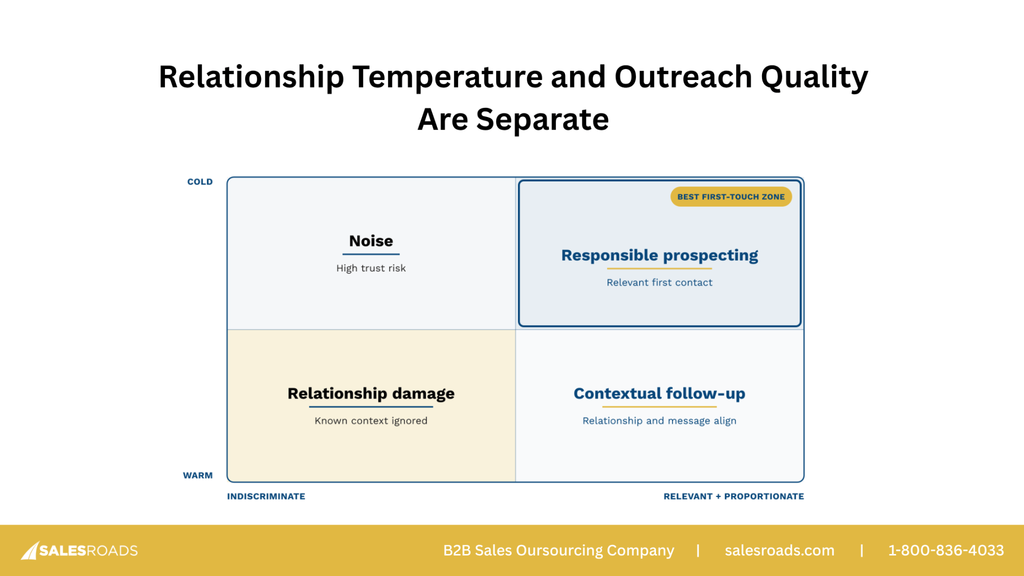
A cold prospect’s first contact should be relevant while avoiding coming across too strong or sales-y. Relationship temperature and outreach quality are two different things; a warm contact can still get a careless message, which is why managers must coach both dimensions independently.
Responsible cold contact usually has six elements:
- A clear fit hypothesis: The account and role connect to a real problem the seller can address.
- Verified contact data: The team checks the person, role, company, and usable channel before outreach.
- Relevant context: The outreach message explains why this person or account was selected without pretending a relationship exists.
- Clear identity: The sender and company are easy to recognize.
- A proportionate next step: The first ask seeks a conversation, a fit check, or permission to continue.
- Respect for refusal: The team records opt-outs and “do not contact” requests and stops all outreach.
The immediate goal is to start a useful conversation, test fit or interest, and earn a legitimate next step. That may be a short discovery call, a referral to the right person, permission to send information, or a clear no that prevents wasted follow-up.
Cold outreach is a standard sales practice, but that’s no excuse to be spammy. You’re crossing into spam territory if you:
- Blast the exact same generic template to hundreds of people at once.
- Pitch a product to a job title that has absolutely no use for it.
- Use deceptive subject lines like “Re: Our meeting” when no such meeting occurred to trick a buyer into opening an email.
- Follow up endlessly without adding any new value.
Compliance Follows the Channel and Method
Although U.S. communication compliance rules treat “cold” as a sales label rather than a legal category, cold outreach must abide by certain regulations. They look at what’s sent and through which channels, who receives it, which technology is used, and where the parties are located, so you need to study the relevant laws to avoid legal issues down the line.
Commercial Email
The CAN-SPAM Act regulates all commercial emails, including B2B. Core requirements include accurate header information and subject lines, clear identification of the message as an advertisement, a valid physical postal address, a clear opt-out option, and honoring opt-outs within 10 business days. This is the federal baseline; state privacy rules, industry restrictions, international recipients, and platform policies can add other requirements.
Manual B2B Calls
The Telemarketing Sales Rule (TSR) exempts most B2B cold calls from consumer regulations, like the National Do Not Call Registry. However, that exemption isn’t a free pass. B2B callers are still prohibited from using deceptive sales tactics, and strict rules apply if you sell certain products like office supplies. State laws and other federal rules can add restrictions at any time, too, so check back regularly to make sure you stay compliant.
Automated, Prerecorded, and Residential Outreach
Phone outreach is heavily regulated by the FCC, and compliance requirements depend heavily on both the technology you use to make the call and the line type you contact. Technology covers how you deliver the message (e.g., manual dialing versus automated dialers, AI bots, or prerecorded voice). Line type refers to what device you’re reaching (i.e., mobile phone, residential landline, or B2B landline). Mobile devices and residential landlines carry the strictest legal protections, especially when paired with automated dialing tools.
To remain compliant with the FCC’s telephone solicitation rules across phone channels, your outreach must abide by these rules:
- Identification: Any automated or prerecorded message must clearly state the caller’s name and the business they represent at the very beginning, along with a valid callback phone number.
- Do-Not-Call (DNC) Compliance: You can’t call numbers on the National Do Not Call Registry, and your company must also maintain an internal DNC list. If a contact asks not to be called, you have to log their request and honor it for at least five years.
- Calling-Hour Restrictions: Sales calls to residential lines or personal mobile phones can only be made between 8:00 a.m. and 9:00 p.m. in the recipient’s local time zone.
- Opt-Out Mechanisms: Prerecorded telemarketing messages must include an immediate, automated way for the listener to opt out (such as pressing a key or speaking a command) right at the start of the call.
- Consent Revocation: Buyers can revoke their consent to be contacted at any time using any reasonable method (e.g., saying, “Take me off your list,” or texting “STOP”). Your team must honor these requests promptly.
Social Media and Direct Messaging
Direct messaging (DM) outreach on platforms like LinkedIn, X, or Instagram requires a completely different compliance mindset. Social networks are private ecosystems governed by their own private rules. So, even if a direct message is technically legal under email laws, a platform can penalize, restrict, or permanently ban your account for sending bulk messages or using unauthorized automation tools.
Social networks also monitor user feedback, message velocity, and connection acceptance rates. Blasting generic pitches or sending too many connection requests in a day will only end up with the platform’s algorithm flagging your account as spam. Buyers view social DMs as conversational spaces. Respect platform-specific boundaries by keeping outreach highly targeted, manual, and focused on real engagement rather than automated cold pitching.
U.S. Compliance Cold Contact Checklist
- Name the channel and transmission method.
- Identify the recipient or line type.
- Confirm whether automation, prerecorded audio, or artificial voice is used.
- Check federal requirements and any applicable state and platform rules.
- Preserve opt-outs, “do not contact” requests, and sender identity.
- Archive records and maintain retention schedules.
Best Practices for Cold Contact
To turn cold contacts into warm relationships, teams must balance strategy, message quality, and disciplined execution.
Lead With Research and Intent
The goal of a first touch is to start a conversation, not close a deal. In modern B2B sales, outreach should be anchored to real buying signals like recent funding rounds, new executive hires, or earnings commentary. Use this account-level research to highlight a specific pain point or trigger event before asking for a buyer’s time.
Deploy a Coordinated, Multichannel Cadence
Relying on a single channel lowers your odds of connecting and increases the risk of looking like spam. Combine cold emails, strategic cold calls, and targeted LinkedIn touches to boost your chances of success. Coordinated omnichannel sequences reach buyers where they’re most responsive.
Follow up Strategically and Test Iterations
Treat your outreach as a feedback loop. Industry benchmarks show the majority of replies come after the first message, yet nearly half of sales reps abandon their sequence after just one unanswered touch. Build structured follow-up cadences where each touch adds new value, and routinely A/B test subject lines, email length, and value propositions.
Standardize Your Warm-up Triggers
Ensure the entire team agrees on exactly what moves a contact from cold to warm. A passive ad click shouldn’t change your approach. But a direct reply, booked meeting, or referral from a colleague should immediately shift the rep into a highly personalized, context-driven motion.
Maintain Strict List Hygiene and Deliverability
Bad data leads to bounced emails, wasted dials, and major compliance risks. Regularly clean your CRM and verify contact information. Proper domain authentication (SPF, DKIM, DMARC) and rigorous tracking of opt-outs and DNC requests are no longer optional. They’re now mandatory baseline requirements to protect your brand and ensure your outreach actually lands in inboxes.
The Bottom Line
Think of cold contact as a label for your level of familiarity with a lead. It requires teams to define the exact relationship, name the channel used to reach them, and evaluate outreach quality separately from lead warmth. By setting clear criteria for when a lead turns warm, avoiding spammy behavior using relevant and honest messaging, and maintaining strict compliance, you can make a predictable, professional outbound program that turns icy leads into warm opportunities.
If you struggle to build and run a completely researched, coordinated outbound motion, request a conversation with the SalesRoads team and learn how we can help.
FAQs
Is cold contact the same as cold calling?
No. Cold calling names a method, usually a phone call made without prior contact or a lead. Cold contact is a broader term that can describe the person or account being approached or the first approach itself. A cold call, email, or LinkedIn connection is a type of cold contact.
Is a contact still cold if they don’t answer an email?
Yes, depending on the team’s definition. Although the seller has created outreach history, the buyer hasn’t created reciprocal engagement or changed the relationship context. Sending a cold email doesn’t instantly warm up a relationship, especially if they don’t reply.
When does a cold contact become warm?
A contact usually becomes warmer when the buyer provides relevant context through a reply, referral, meeting, information request, or another meaningful exchange. There’s no universal threshold that explicitly separates warm and cold leads. Teams should therefore define which signals change the label and avoid treating passive awareness or an unreciprocated seller touch as automatic warmth.
Is cold contact legal in B2B sales?
Yes, it’s legal, but companies have to follow certain regulations surrounding it. U.S. requirements vary by channel, technology, recipient, their location, and the message content. Commercial email, manual B2B calls, automated or prerecorded messages, residential solicitations, and direct messages can follow different rules as well. Review the actual program in line with state and federal laws, in particular the FTC.