- A B2B sales strategy connects the business objective, target buyer, change case, sales motion, and operating system that turns evidence into better decisions.
- Tactics, processes, playbooks, and technology create leverage only after the strategic choices reinforce one another.
- The right sales motion fluctuates with deal economics, buying complexity, buyer tasks, and the cost of serving the account well.
- Improvement starts by locating the constraint, then using comparable data and buyer evidence to test the strongest explanation.
- Scale requires repeatability and clear ownership. Technology and external capacity create value after the market, value, qualification, and feedback rules are defined.
When B2B sales underperform, the usual response is to add more. Teams add activity, channels, software, sequences, reporting, or headcount. The system becomes busier, but the root problem remains: A broad target market creates noisy outreach, a weak change case creates interest without urgency, or a mismatched sales motion consumes capacity while leaving the buyer’s decision work unfinished.
A strong B2B sales strategy makes the underlying choices explicit and connected. It links the business objective to the buyers worth pursuing and the problem that gives them a reason to act. It defines the sales motion, the resources required to deliver it, and the evidence that triggers a revision. That operating logic gives the team something it can execute, diagnose, and improve.
What is a B2B Sales Strategy?
A B2B sales strategy is a company’s connected set of choices about which customers to pursue, what problem gives those customers a reason to act, how the company will create and convert demand, what resources it will commit, and how it will learn. A sales process, methodology, playbook, tactic, or technology executes part of that logic. Strategy tells the team where to focus, what to deprioritize, and what evidence justifies changing course.
Business objectives, capability needs, investment priorities, metrics, and buyer engagement must support the same sales approach. The target segment determines the sales motion. The motion then sets the required execution capacity, the acceptable cost to serve customers, and the metrics the team should track.
How sales strategy differs from related terminology
Strategy chooses the operating logic. Eight adjacent objects turn parts of that logic into action.
- Sales strategy chooses the target, value logic, sales motion, resource priorities, and learning rules.
- Sales plan translates those choices into time-bound targets, territories, budgets, quotas, and initiatives.
- Sales process turns the chosen motion into stages, decision gates, and ownership for advancing opportunities. A defined sales process prevents the strategy from dissolving into individual rep habits.
- Sales methodology guides how sellers handle a specific interaction, such as discovery, qualification, or value articulation.
- Sales framework organizes questions or conditions so leaders can analyze a decision. It sharpens the thinking, while the company still makes the choices.
- Sales playbook codifies approved guidance, examples, criteria, scripts, and procedures for repeatable situations.
- Sales tactic is a discrete action, message, channel use, or technique.
- Sales motion is the recurring pattern used to acquire and expand a defined customer segment.
Within the wider practice of B2B sales, strategy is the layer that allocates focus, investment, and learning. The other layers make those decisions repeatable.
A practical B2B sales strategy framework built on connected choices
A fruitful B2B sales strategy requires a few unshakeable pillars to support it. The framework below covers four such areas. It starts with the business goal, target market, and financial limits. Then it explains the buyer problem and the reason to act. The third section covers the sales motion and channel mix, and the last section addresses ownership and feedback.

1. Business objective, target market, and economic guardrails
Start with the business result the sales system must support. The goal may be to win new customers, grow revenue from existing accounts, enter a new market, improve margins, shorten the path to revenue, or reduce dependence on a small number of customers. Each goal changes where the team should focus.
Then choose where the company will focus. According to scientific study, segmentation criteria should reflect the job the segment is meant to perform and the way the company will target it. A target market becomes attainable by narrowing resource allocation. “Mid-market companies” is too broad. The team needs priority rules built from industry, operating condition, account signal, buyer problem, and economic fit. Those rules give the ideal customer profile (ICP) the strategic job of translating market focus into observable signals for research, qualification, and coverage.
Economic guardrails test whether the chosen motion is viable. Expected contract value, gross margin, sales cycle length, implementation cost, retention potential, and cost to serve set the limits of the coverage model. Complex, high-value purchases can justify a high-touch enterprise motion, but that same cost structure makes a simpler offer unprofitable.
You can’t treat every initiative as a priority. Each one takes time from sellers and managers, so your growth plan should also identify work your team will stop doing. Activities that no longer support the target market or business goal should lose priority.
2. Buyer, change case, and differentiated value
Choosing an account demands pinpointing the buyer problem and the change the company wants to create.
The strategy must answer four questions:
- What operating problem or opportunity matters to this buyer?
- Why should the buyer change the current state?
- Why should the buyer act now?
- Why is this company a credible choice?
A pain point creates interest, while urgency comes from the consequences of staying put. Buyers also look for proof that reduces the risk of change, as Forrester found. Implementation confidence and a clearer path to the outcome often matter more than a particular feature. The change case has to help the buyer understand the product and justify action inside the buying organization.
A value proposition turns that strategic logic into buyer-facing language and proof. Strategy decides which value deserves emphasis, which evidence makes it credible, and how the motion adapts it for different stakeholders while preserving the core reason to change.
3. Sales motion, channels, and buying-group coverage
A sales motion should fit the account value and the steps buyers must complete before they can approve a purchase. As the Journal of the Academy of Marketing Science revealed, sales rep interactions can increase contact volume, but their quality may fall in complex sales that require more explanation and coordination. These purchases usually need discovery, technical review, stakeholder alignment, and executive approval. Choose the interaction that helps the buyer complete the next step without skewing the account’s cost-to-benefit ratio.
Channel design covers how buyers research, evaluate, and complete a purchase. McKinsey discovered that buyers use an average of 10 channels across digital, remote, and in-person interactions. Digital channels support research and routine progress, while remote specialists answer technical or commercial questions. In-person meetings are most useful for decisions that involve more risk, coordination, or trust.
The role of the sales rep has evolved to helping buyers validate information and apply it to purchase decisions. Gartner drives home that point, revealing that 69% of surveyed buyers prefer to validate AI-generated information with a sales rep. Prospects can handle routine research independently, but they should be able to reach a knowledgeable seller for questions that need context, coordination, or risk reduction.
Buying groups often contain conflicting objectives as well, so strategy coverage should connect individual concerns to shared business priorities. It should also define the role of each channel, show where experts enter, and keep the cost of coverage in line with the account’s value.
4. Operating capacity, ownership, and feedback loops
Clear decision rights and operating responsibilities make a strategy executable. Assign explicit ownership for account selection, prospecting and qualification, technical validation, the commercial close and handoff, customer feedback, and the decision to change the strategy.
Concrete agreements make cross-functional work observable. Shared definitions, service levels, escalation paths, data ownership, review cadence, and feedback routes show how the motion operates. They also reveal where local optimization is damaging the system, such as marketing maximizing lead volume while sales rejects the accounts, or sales accelerating acquisition while delivery and retention deteriorate.
Feedback needs its own clear path into decision-making. Outreach shows which messages earn attention, which objections repeat, and which account traits predict a stronger response. Marketing then adds demand and content signals, and customer success shows whether the promise made during acquisition holds after the sale. Leaders should review these signals together, record what they indicate, and decide whether to adjust the segment, message, qualification rules, sales motion, or resource allocation.
Recommended Listen: Three Frameworks for Stronger Sales Strategy with Ralph Barsi
Ralph Barsi, VP of sales at Kahua, presents three practical ways to make strategy visible. The “strategy slide” distills priorities, “plan on a page” connects initiatives and measures, and the six-page narrative exposes assumptions and dependencies.
The conversation extends this section by showing how leaders turn strategy from a meeting topic into a shared object that teams can coordinate around, challenge, and revise.
B2B Sales Strategy Examples for Common Sales Motions
Market, value, coverage, capacity, and learning have to move together. These five choices produce different configurations as the motion changes.
New-market outbound
A company entering a new market has to create demand while simultaneously learning which buyers respond. Start with one clearly defined customer segment, a reason those buyers should act, and a message the team can test. Use outreach to compare responses, objections, and meeting quality. If the same concerns keep appearing, revise the target, message, timing, or proof before adding more volume.
Enterprise account-led selling
Enterprise selling puts more time and expertise into a smaller set of high-value accounts. Map the buying committee, the business and technical risks, the proof each stakeholder needs, and the final approval process. Use digital content, specialists, direct outreach, and in-person meetings where appropriate to move all committee members closer to deal closure. Repeated no-decisions, missing stakeholders, or sales and service costs that leave too little margin signal that the approach needs to change.
High-velocity inbound
A high-velocity inbound motion depends on clear intent signals, a fast response, consistent qualification, and an easy path to value. Automation can route and enrich leads while sellers focus on opportunities that need human judgment. Watch qualified conversions, retention, and margins as volume grows. More leads don’t help if they create extra work without better results.
Existing account expansion
Existing-account growth starts with the depth of adoption, relationship health, account potential, and unmet needs. Customer-success feedback, product usage, account planning, and direct conversations help identify credible opportunities. Protect the current relationship and involve sales when there’s a clear reason to expand. More contact just means more messages. You know you’re making progress if customer value, retention, and opportunity quality improve.
How to Build or Revise a B2B Sales Strategy
A revision loop connects evidence to decisions in five steps:
1. Define the economic and buyer problem.
State your business goal, target segment, buyer problem, and financial limits. Define the expected outcome so you can test the strategy and see if anything needs to change.
2. Audit the current motion and available evidence.
Review results by segment, stage movement, buyer feedback, win-loss reasons, delivery or retention problems, and the team’s capacity. Use the same definitions and time periods for every comparison.
3. Locate the biggest constraint.
Identify the most likely constraint in the target, change case, value, motion, process, capacity, data, or learning system. Weak pipeline may reflect low activity, poor fit, unclear value, bad data, slow follow-up, or the wrong channel.
4. Choose one priority and a tightly controlled test.
Change one part of the sales motion at a time. Narrow the segment, revise the message, add a missing stakeholder, fix a handoff, or experiment with one workflow. Decide in advance what result would support the change, what would disprove it, and when the test should stop.
5. Decide if you should update, scale, or stop.
Compare the result with your baseline and review what buyers and sellers reported. Perhaps you only need to make a small tweak, or maybe one step in the system needs a complete overhaul. Stop if the change doesn’t achieve the intended result. Expand the adjustment only after the team understands why it worked and where the same conditions apply.
Repeat the process as the market, buyers, and team change. Each test should clarify whether to keep, revise, expand, or stop the current approach.
How to Improve B2B Sales
Improve your B2B sales by identifying which strategic choice or operating dependency is constraining results. Then test the smallest variable that will hone in on a single explanation. Activity volume and one other metric reveal too little to identify the root cause. Compare consistent cohorts, inspect buyer and seller evidence, and trace the symptom back to target fit, value, motion, process, capacity, data, or learning.
Metric definitions shape the diagnosis. Count wins and losses the same way, compare the same time periods, and separate results by source, deal size, market, or sales motion. The numbers show where performance changed. Call reviews, buyer feedback, and win-loss analysis then help explain why.
From sales symptom to bounded test
| Signal | Likely constraint | Evidence to review | First test |
| High activity, low qualified response | Target or change case | Response by segment, no-response reasons, and loss reasons | Narrow one segment and test a sharper change case |
| Meetings rarely become opportunities | Qualification, value, or handoff | Conversion, disqualification reasons, and follow-up ownership | Tighten qualification and handoff rules |
| Opportunities stall or end in no decision | Coverage, risk, or proof | Stage age, stakeholder gaps, and objections | Add the missing stakeholder, proof, or risk step |
| One channel creates volume with weak margins | Channel fit | Conversion, cycle length, margin, and buyer preference | Test another channel mix for one segment |
| Results vary by rep, region, or source | Process, data, or capacity | Cohort results, data completeness, and account load | Fix one operating issue before changing strategy |
| Growth depends on one founder, account, or campaign | Repeatability | Concentration, retention, margin, and cohort stability | Repeat the motion with one comparable cohort |
| Tools raise activity without better decisions | Workflow or technology fit | Time, quality, errors, and data readiness | Pilot one workflow with success and stop rules |
Move from the symptom to the likely cause, review the evidence, and run a small test before redesigning the sales motion. If several culprits remain plausible, choose the low-cost test that’s easiest to undo and most likely to improve the next decision.
Signs a B2B Sales Strategy is Ready to Scale
A repeatable sales motion can win and retain customers beyond a small group of founders, sellers, or existing relationships, as McKinsey research proves. The team can teach the qualification logic, explain why buyers choose or reject the offer, support the promise through delivery and retention, operate within viable margins, and detect when the model starts to drift.
When to move beyond founder-led sales
Founder-led selling is useful while the company is still learning the market. Founders can adjust the offer, interpret early signals, and connect product decisions to buyer conversations. Adding roles and handoffs too early creates complexity before the sales motion is repeatable. The buyer, value, and qualification logic should be clear enough for another seller to use.
Move sales work beyond their scope after the company can win customers outside the founder’s network, the founder becomes a capacity bottleneck, another seller can use the same qualification and value logic, and delivery quality remains stable. Until then, the founder should stay close to customer conversations.
When CRM, automation, and AI are helpful
Adding tools to fragmented workflows rarely improves commercial performance, according to McKinsey’s data. Stronger results come from redesigning workflows, roles, data, governance, and adoption around a clear objective. Sales teams also need reliable data, clear ownership, and human review.
Choose one measurable sales problem and record the current completion time, output quality, and error rate. Fix missing, duplicated, or unreliable data that the workflow depends on, then pilot the tool with a small group and review where it fails. Expand it only after it improves the intended task or decision. Login and message counts show use, but workflow speed, output quality, cost, and business results determine if the tool is actually useful.
When external SDR or appointment-setting capacity fits
The make-or-buy decision starts by separating the work a partner can perform from the decisions the company must keep in-house. An organization can confidently delegate repeatable tasks such as account research, data validation, coordinated outreach, conversation capture, or reporting. But they should keep ownership of the target market, buyer value, qualification criteria, branding, follow-up, and the decision to change direction internal. When evidence from the field challenges the strategy, someone inside the company must have the authority and context to respond.
Seek outside help when the team can define a qualified conversation, explain the offer and its proof, and identify a measurable recruiting, management, data, or coverage gap in an otherwise viable motion. Unresolved product-market fit, a vague value proposition, and weak domain feedback make external capacity premature.
Activity targets define only one part of the relationship though. Both the company and partner also need shared quality standards, clear escalation rules, and a way to review what buyer conversations reveal.
Our methodology uses two linked loops to connect strategy and execution. The program loop sets the target, message, qualification criteria, and outreach design, and the outreach loop returns buyer language, objections, timing, and account patterns. This keeps strategic decisions inside the company while execution continues to produce useful evidence.
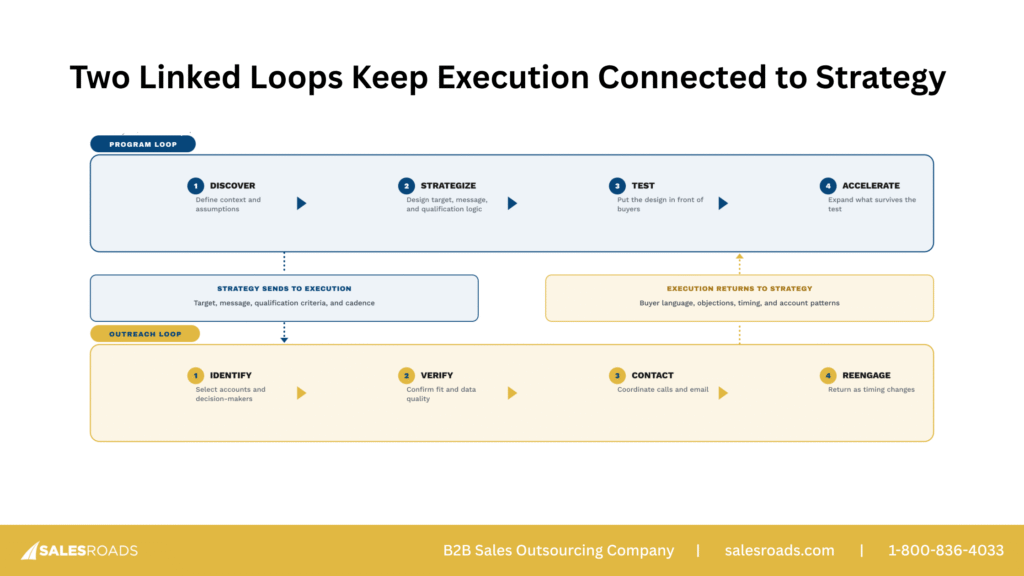
This structure best fits a company with a defined target and value logic who struggles with execution capacity. An outsourced SDR program or appointment-setting service can add account research, data operations, coaching, and coordinated outreach. Internal leaders use the accrued buyer evidence to decide whether the target, message, or qualification rules need to change. Our role is to add execution capacity while keeping buyer evidence connected to strategic direction.
Conclusion
An effective B2B sales strategy connects the buyer, value, motion, resources, ownership, and learning rules into one operating logic. That coherence gives the team a basis for its focus, makes execution easier to coordinate, and exposes weak assumptions before they consume more budget and capacity.
Weak results call for diagnosis before redesign. Locate the constraint before changing everything at once by testing the smallest meaningful change. Then scale when the motion is repeatable, economically viable, deliverable, and capable of learning. External capacity becomes a sensible option when the strategy is clear and issues remain concerning execution, management bandwidth, data operations, or coverage. To assess if your sales motion needs outside help, request a quote from SalesRoads.
Frequently Asked Questions
How often should a B2B sales strategy change?
Review the strategy on a regular operating cadence and whenever evidence changes a core assumption. Triggers include a new segment, a shift in buyer behavior, deteriorating economics, repeated no-decision outcomes, a product change, or a motion that no longer fits available capacity. A short-term metric move triggers investigation. A change in a core assumption triggers a strategy change.
Can an early-stage B2B company use a formal sales strategy?
Yes, at a level of formalization that matches the company’s learning stage. An early strategy can be concise and explicit about target buyers, the change hypothesis, the initial motion, and what the team needs to learn. Add process, specialized roles, and tools after another seller can repeat the sales motion and the team needs clearer coordination.
Which metrics should leaders review first when B2B sales underperforms?
Start with measures that locate the stage and segment where performance changed. Review qualified response, meeting-to-opportunity conversion and stage movement, no-decision reasons, cycle time, margin, retention, account concentration, and capacity. Use consistent definitions and pair the numbers with call reviews, buyer feedback, and win-loss evidence.
Is CRM or AI part of a B2B sales strategy?
CRM and AI are enabling capabilities inside the operating model. They can improve data access, workflow speed, prioritization, and seller support when the process and ownership are clear. However, the company still chooses the market, buyer value, sales motion, qualification logic, and the evidence that triggers a change.
When should a company consider outsourced SDR or appointment setting?
Consider partnering with an external agency when the target, value, qualification, brand standards, and follow-up ownership are clear, and a defined recruiting, management, coverage, or execution gap remains. Keep the work internal while the company is still discovering product-market fit, inventing the value proposition, or unable to provide continuous feedback.