- A sales plan turns a set goal into connected, actionable choices about the market, capacity, initiatives, resources, ownership, and review evidence.
- Test the goal against qualified opportunities expected to close during the planning period, as well as conversion rates, sales cycle timing, ramp, and productive capacity before funding initiatives. Dividing a target across the team doesn’t make it feasible.
- Use three connected records: the Planning Frame holds the approved baseline, the Decision Register captures current commitments, and the Operating and Revision Log shows which decision or assumption new evidence may change.
- Define what criteria can reopen a decision before execution. When that evidence appears, preserve the baseline and record what changed, why, who decided, and when the new version took effect.
A revenue target can gain approval before everyone’s even agreed on how to reach it. The team still needs a shared view of the accounts in scope, the capacity available during the period, the initiatives that merit resources, and the evidence that would justify changing course. A sales plan resolves those decisions and keeps the approved reasoning visible through execution.
Planning already takes a meaningful share of the sales week. In fact, Salesforce calculated it as consuming 16% of a sales rep’s average week. The value of that time depends on what it produces. A useful plan gives the team decisions it can inspect, execute, and revise.
What Is a Sales Plan?
A sales plan records how a team will pursue an agreed sales goal during a defined period. It names the market and sales approach, tests the target against local funnel assumptions and capacity, commits resources and owners, and states the evidence and conditions for reopening a decision. It also defines what the team will do if results differ from the approved baseline.
Sales planning happens at several levels, from long-range company direction and annual planning to territory and account decisions. It involves several tools, each of which answers different questions:
- Sales strategy defines the market position, priorities, and broad route to growth.
- A sales plan converts that direction into decisions, resources, ownership, deadlines, and change conditions.
- A sales process defines recurring stages that opportunities move through.
- A sales forecast estimates likely results from current conditions.
- Quota, territory, and account plans govern narrower decisions that may feed the main plan.
Our Three-Part Sales Plan for Clear Operations
Crafting a sales plan takes time and attention. To keep it on the right course, use three connected records: a Planning Frame for the approved baseline, a Decision Register for current commitments, and an Operating and Revision Log for evidence and changes. Complete the blank records below as each planning stage produces a decision, then compare them with the finished example.
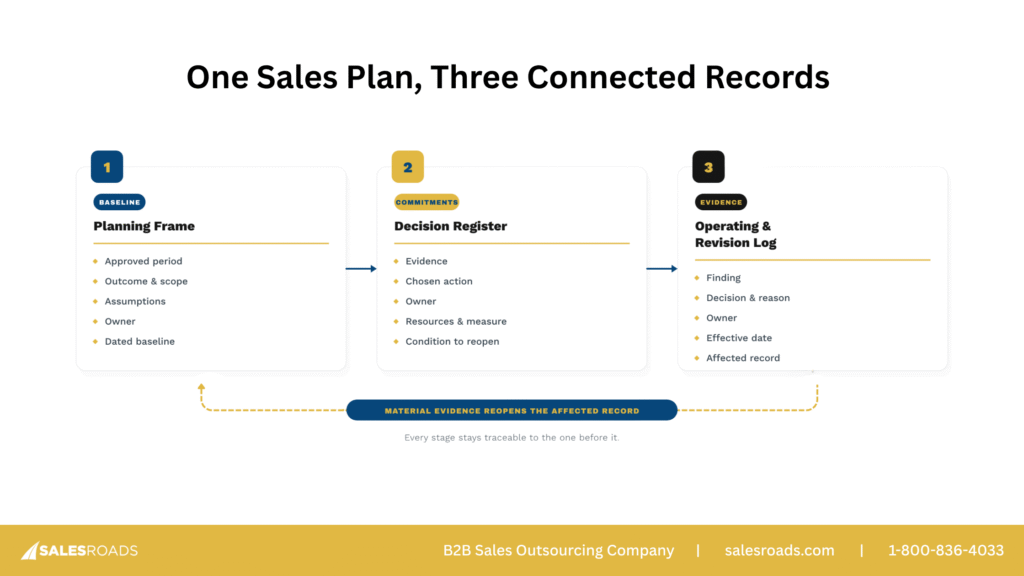
Sales planning covers forecasting, goal setting, incentive design, territory and quota setting, and go-to-market strategy. A usable sales plan coordinates those decisions without mixing them together. The three records can live in the same workbook or application while giving the approved baseline, current commitments, and dated changes their own place. That separation lets the team connect new evidence to the exact decision or assumption it affects.
1. Planning Frame
The Planning Frame states what’s already been approved. Keep it simple enough to reread before any major decision. If the outcome, market, motion, or governing assumptions are unclear, record that uncertainty so later actions don’t absorb it.
| Field | What to record |
| Planning period | Start and end dates for the decisions governed by this plan |
| Business or sales outcome | Result, unit, amount, and deadline |
| Target market or account set | Segment, territory, named accounts, or customer group in scope |
| Scope and sales motion | Team, channels, offers, and covered funnel stages |
| Governing assumptions and evidence | Approved strategy inputs, current facts, and material assumptions |
| Plan owner | Person accountable for maintaining the plan |
| Approved baseline and date | Version approved for execution and its approval date |
2. Decision Register
The Decision Register captures the choices that commit people, money, time, or operating capacity. Each entry should show what reasoning led to the decision, what the team chose, who owns the result, and what later criteria could reopen it.
| Decision or priority | Evidence and assumptions | Chosen action | Owner and resources | Measure and evidence to reopen |
Recommended Listen
In the Three Frameworks for Stronger Sales Strategy episode of the Sell Like a Leader podcast, I spoke with Ralph Barsi, VP of sales at Kahua and advisor at Scale Venture Partners. We used two tools to show how leaders carry strategy into operations. The strategy slide connects a goal to initiatives, measures, and stakeholder needs. Plan on a page, meanwhile, adds priority, owner, and status so another leader can grasp the objective and current state at a glance.
Ralph also explained how individual leaders’ pages can expand into a wider team view. Together, those ideas offer a practical test for the Decision Register. The team should be able to see what it’s trying to achieve, why each initiative exists, who owns the next move, and what current evidence says.
3. Operating and Revision Log
The Operating and Revision Log records observed results, decisions, and effective changes after approval. It keeps each new decision next to the baseline it changes, so assumptions don’t shift without explanation.
| Evidence and date | Finding | Decision and reason | Owner and effective date | Baseline or prior decision affected |
How to Develop a Sales Plan
Build the plan in six stages: Set the frame, gather local evidence, test the target against capacity, choose initiatives, assign owners and resources, and define the evidence that could change a decision. Each stage should leave a usable part of the three-record template, even when the same owner and evidence allow the team to combine steps.
1. Determine the Planning Frame
Start with the period of time and the specific desired outcome. Give the goal a unit and a deadline. “Twelve new customers by the end of the second quarter” is easier to plan for than “grow revenue” because the team can connect that outcome to opportunity requirements, cycle timing, and capacity.
Next, name the market and sales approach. A plan for mid-market, new-logo outbound uses different assumptions and resources from an expansion plan for existing enterprise accounts. If the plan covers both, separate their targets and evidence so one approach doesn’t hide the other.
Record the governing strategy inputs that are already approved. Positioning, offer, target market, and broad channel choices usually belong upstream. Any unresolved choice that will consume resources belongs in the Decision Register. Finish the frame with one accountable owner and a dated baseline.
A first populated frame could name the next two quarters as the period and 12 new mid-market customers as the outcome. It could then record “focused outbound plus current qualified pipeline” as the motion, “VP of Sales” as the owner, and “January 15” as the baseline approval date.
2. Gather Local Evidence and State Your Assumptions
Strong planning combines front-line judgment with real data. Salespeople and managers see account quality, buying friction, competitive movement, and message response before those changes become stable trends. Data keeps that judgment in check and shows whether an observation is local, repeated, or large enough to change a decision.
Gather inputs in the order the plan will use them:
- Pull current performance by clearly defined funnel stage.
- Separate in-period pipeline from qualified opportunities that can’t close during the planned period.
- Review conversion patterns, deal size, average sales cycle length, and the range of cycle lengths.
- Add market opportunity data for the segment, territory, and account set.
- Check ramped capacity for the reps creating opportunities and the team receiving them.
- Record operating dependencies, including budget, data, tools, and enablement.
- Ask sellers and managers what the numbers fail to explain.
Material assumptions need an owner and a date. When you record a percentage, state what it’s measured against. A 25% win rate, for instance, means little unless the plan says whether it applies to qualified opportunities, all opportunities, or every lead. If evidence is thin, use a range or provisional value and name the event that will replace it. An unlabeled estimate can otherwise drive every downstream requirement, including the 48 opportunities, capacity plan, and budget, as though the team had already observed it.
3. Test the Target Against Current Capacity
Compare your current capacity to your target before choosing any initiatives. That calculation shows if the goal is feasible under the current pipeline, conversion, cycle, ramp, and receiver-capacity assumptions. A longer ramp, slower cycle, or weaker segment may change the resources and timing required for the same goal.
For instance, a fixed coverage ratio may hide differences in deal size and cycle length. Data from Norwest revealed that planned coverage varied across ACV bands: Average sales cycles rose from roughly two to three months for deals below $25,000 ACV to nine to twelve months above $500,000. Use your own conversion history, cycle timing, capacity, and account economics to gain a clear picture of your abilities before making a commitment.
To demonstrate the process in action, consider a hypothetical B2B team that needs 12 new customers. The values below show how a target translates into an opportunity gap.
| Calculation item | Hypothetical value | Calculation or meaning |
| New customers required | 12 | Planning period outcome |
| Qualified-opportunity win-rate assumption | 25% | Local assumption |
| Qualified opportunities required | 48 | 12 divided by 0.25 |
| Qualified opportunities already in the in-period pipeline | 30 | Only opportunities with matching definition and timing |
| Initial opportunity gap | 18 | 48 minus 30 |
An opportunity gap of 18 is only the first planning result. The team must then test if it can source and qualify those opportunities within the planning period, whether ramped sellers can carry the work, and if AEs can absorb the handoff. When you test whether a quota is realistic, you work backward from historical performance, win rate, deal size, cycle length, ramp, and productive capacity. Those inputs reveal the difference between a target distributed across the team and one the team can actually support.
4. Choose Initiatives That Address the Exposed Gap
Choose initiatives that address the diagnosed gap. If one segment has weak opportunity creation, a broad activity target gives the team little direction. A narrow test defines the account set, message, channel mix, qualification standard, and review evidence clearly enough for the team to judge the result.
The register should also show what stays fixed. A test may change the account set and message while preserving the offer, qualification threshold, and planned handoff. That boundary helps the team understand what the evidence can teach.
| Decision or priority | Evidence and assumptions | Chosen action | Owner and resources | Measure and evidence to reopen |
| Close an 18-opportunity gap | Current pipeline includes 30 of the 48 qualified opportunities expected to close during the planning period | Run a six-week outbound test in the approved segment | SDR manager, two ramped SDRs, research support | Qualified opportunities created and accepted. Reopen if early response or qualification falls below the agreed range |
| Protect opportunity handoff | Added opportunity volume may exceed AE review capacity | Reserve review capacity and use one acceptance standard | Sales director and AE manager | Acceptance rate and response time. Reopen if review delays threaten the planning period |
The opportunity-creation decision addresses the gap. The handoff decision protects a dependency that could make the first action ineffective even if outreach performs as expected.
5. Assign Owners, Resources, and Handoffs
Every consequential decision needs one accountable owner. Contributors, approvers, executing teams, and receiving-team owners can all affect the outcome. Name those roles when a handoff changes quality, timing, or capacity.
The register makes ownership concrete by showing the next decision. The SDR manager may be assigned opportunity creation while sales operations supplies the account data, and the AE manager is responsible for acceptance capacity. If the AE team can’t review new opportunities within the planned window, that constraint needs to be considered in the plan before the campaign launches.
Resources also need names. Record head count, budget, data, tools, enablement, and downstream capacity that the action consumes. A team can then tell whether a missed result came from a weak decision, a broken assumption, or a dependency that was never available.
6. Define Review Evidence and Change Conditions
Define the evidence that would reopen each material decision before execution starts. Set the threshold in advance using your own historical data, then record who decides and when the revised plan takes effect.
List the available responses. The owner may keep the action, adjust the account set, change the message, add resources, extend the planning period, or reopen the target assumption. Record the selected response, owner, and effective date.
| Evidence and date | Finding | Decision and reason | Owner and effective date | Baseline or prior decision affected |
| Week-two test evidence | Qualification is on plan. AE review time exceeds the agreed window | Keep the segment test and add two protected review blocks each week | AE manager, effective next Monday | Handoff-capacity assumption in the original Decision Register entry |
The log preserves the original handoff-capacity assumption and also records the adjustment made in response to the new evidence.
Sales Plan Example: How the Three Parts Work Together
The calculations above now move into the completed records. They show how an 18-opportunity gap leads to three separate decisions: create more opportunities, protect handoff capacity, and keep the target unchanged during the test. The records also reveal how those decisions change as evidence arrives.
Completed Planning Frame
The frame gives every later entry the same period, target set, motion, and baseline. A calculation that uses a different opportunity definition or a later close window needs correction before it can influence the plan.
| Field | Hypothetical entry |
| Planning period | Next two quarters |
| Business or sales outcome | Win 12 new customers by the final day of the period |
| Target market or account set | Approved mid-market segment and named-account list |
| Scope and sales motion | Focused outbound plus qualified opportunities already in the in-period pipeline |
| Governing assumptions and evidence | 25% qualified-opportunity win rate, 30 qualified opportunities expected to close during the planning period, current cycle distribution, two ramped SDRs, defined AE acceptance capacity |
| Plan owner | VP of Sales |
| Approved baseline and date | Version 1 approved on January 15 |
Completed Decision Register
Keeping these decisions separate lets the team adjust opportunity creation or handoff capacity without changing the approved target.
| Decision or priority | Evidence and assumptions | Chosen action | Owner and resources | Measure and evidence to reopen |
| Create the missing qualified opportunities | 12 wins require 48 qualified opportunities at the assumed 25% win rate. The in-period pipeline contains 30, leaving an initial gap of 18 | Run a six-week outbound test across the approved account set with one message hypothesis and the existing qualification standard | SDR manager, two ramped SDRs, one researcher, approved data budget | Qualified opportunities created and accepted. Review the segment or message if two consecutive weekly readings fall below the planned range |
| Protect AE receiver capacity | The current team must review the existing pipeline and any opportunities created by the test | Reserve two weekly AE review blocks and use a consistent set of acceptance and rejection reasons | AE manager, participating AEs, sales operations support | Review time, acceptance rate, and reason-code completeness. Add capacity or narrow volume if delays threaten the period |
| Preserve the target while the test runs | Current evidence supports testing the opportunity-creation assumption before changing the outcome | Keep the 12-customer baseline during the initial six-week test | VP of Sales | Reopen the outcome or period only if cycle timing, segment opportunity, or productive capacity changes materially |
Completed Operating and Revision Log
The log shows three different review outcomes. Week two adjusts capacity, week four records learning without changing the plan, and week six revises a material assumption and starts a new version.
| Evidence and date | Finding | Decision and reason | Owner and effective date | Baseline or prior decision affected |
| Week two | Early qualification is inside the planned range. AE review takes longer than the agreed window | Keep the account set and message. Add two protected AE review blocks because receiver capacity is the current constraint | AE manager, effective next Monday | Decision Register entry on AE receiver capacity |
| Week four | Review time has recovered. Accepted opportunity volume remains inside the planned range | Keep the action unchanged and continue collecting evidence through week six | VP of Sales, effective immediately | No baseline change |
| Week six | The test created fewer accepted opportunities than the plan required, while one subsegment performed materially better | Narrow the next test to the stronger subsegment and update the opportunity-creation assumption. Preserve Version 1 for comparison | VP of Sales and SDR manager, effective at the start of the next test | Segment assumption and opportunity-creation action in Version 1 |
How to Use and Revise the Sales Plan
Compare any new evidence to your approved baseline. If an assumption or dependency has changed noticeably, update the relevant action, resource, target, or assumption, assign an owner and next step, and record when the new version takes effect. If the evidence remains within the agreed change condition, keep the current decision and record what the team learned. This keeps the baseline visible without turning routine monitoring into constant replanning.
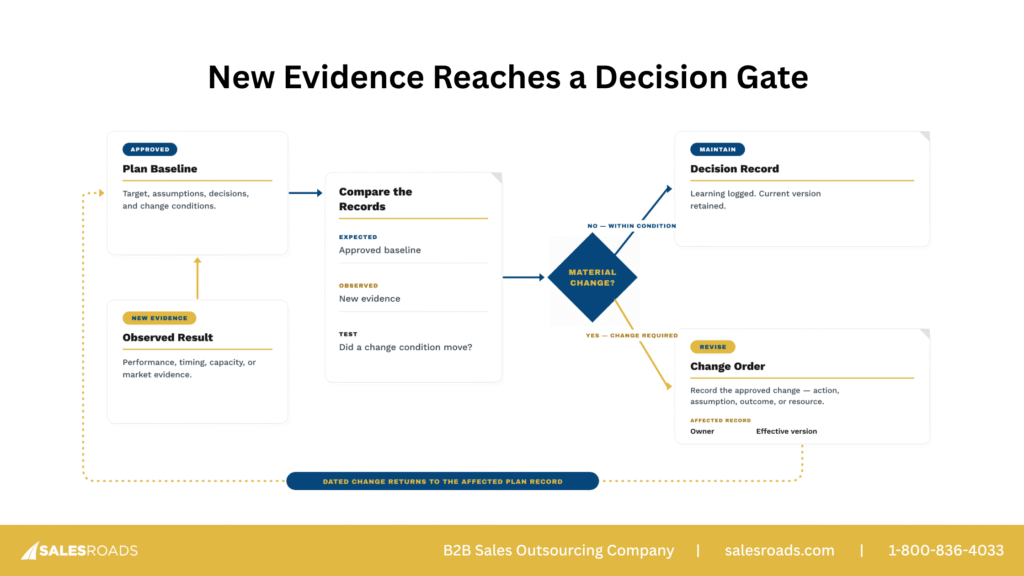
A regular review begins with the difference between expected and observed results. Diagnose the source before changing the plan. A pipeline gap can come from weak account selection, low response, poor qualification, slow handoff, limited receiver capacity, or an assumption that no longer fits the market. Each diagnosis points to a different decision.
At SalesRoads, our methodology starts with business goals, market, and constraints, then moves through strategy, live execution, and feedback from conversations and operating metrics. That feedback returns to the decision record so the original rationale remains visible while the motion improves.
That sequence is visible in our Parker Hannifin distributor campaign: We began with the target markets, customers, competitive landscape, and value proposition. Those choices shaped qualification, sales-qualified-lead distribution, follow-up, and monthly monitoring. The campaign identified 541 sales-qualified leads representing an estimated $25 million in annual opportunity. The map below follows that operating path and places both reported outcomes where they become visible.
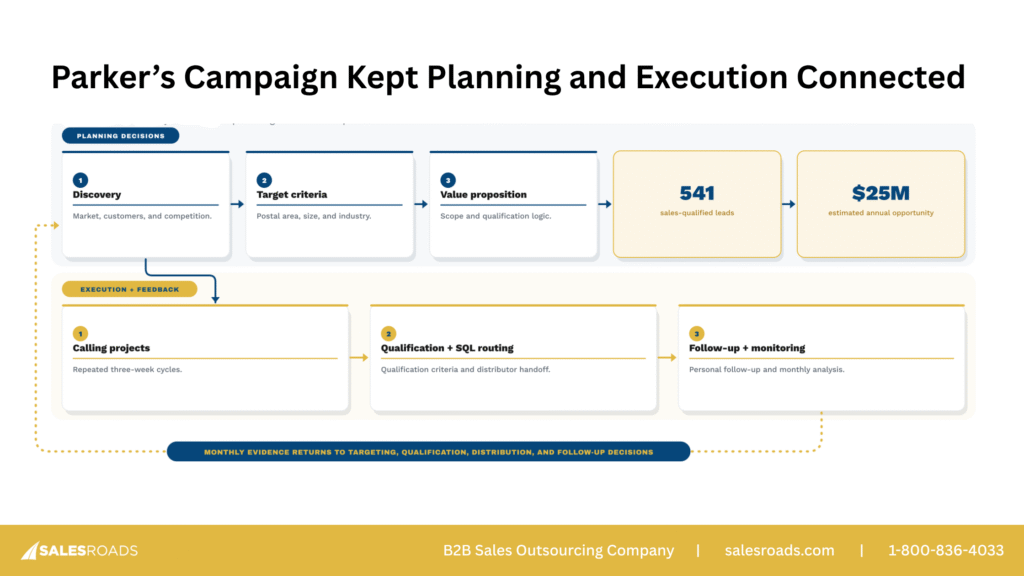
Monthly monitoring connected the reported outcomes to the targeting, qualification, distribution, and follow-up decisions set during discovery.
Build a Sales Plan Your Team Can Use With Ease
A finished sales plan makes a hard conversation easier. Leaders can see whether the target is feasible, which initiatives received resources, who owns the next move, and what evidence can reopen the decision.
The three records protect different parts of that conversation.
- The Planning Frame keeps the approved baseline stable.
- The Decision Register connects evidence to commitments.
- The Operating and Revision Log gives new information a disciplined route into the plan.
Together, they let leaders make clear recommendations while keeping the evidence and ownership visible.
Execution will teach the team something the initial plan couldn’t know. If the plan exposes a pipeline gap your current team can’t cover, talk with SalesRoads about whether an outsourced SDR program fits the gap. The same Planning Frame gives that conversation a concrete market, capacity requirement, qualification standard, and handoff boundary.
FAQ
What time period should a sales plan cover?
Set the planning period around the target deadline, sales cycle, and how quickly the plan’s material assumptions may change. A plan may cover a year, while some decisions use shorter review windows. Keep the planning period separate from those reviews. Change it only when new evidence alters a material assumption, target, or resource decision.
What is a sales development plan?
In a sales-planning context, a sales development plan defines how SDR or BDR teams will create and qualify pipeline within a broader sales plan. It covers target accounts, outreach, qualification, capacity, and the handoff to sales. This type of plan is distinct from an individual development plan focused on a salesperson’s skills or career growth.
Do small businesses need a formal sales plan?
Yes. A small business sales plan may be brief, but it still needs to record target customers, the sales goal, key assumptions, chosen actions, ownership, required resources, performance measures, and conditions for change. The most critical component here is a clear distinction between the baseline, current commitments, and later revisions.
Do you need CRM or sales-planning software to create a sales plan?
No. A maintained document or spreadsheet can work when definitions, decisions, owners, evidence, and change rules are clear. Software earns its place once data volume, scenario complexity, collaboration, access control, or version history exceeds what a simple artifact can manage reliably. Choose the tool after defining the planning decisions it needs to support.