- Technology appointment setting uses the same core steps as other B2B outbound strategies. The extra challenge is knowing which technical questions the SDR should handle and which belong with a specialist.
- Appointment setters should confirm the right account and buyer, as well as a real business problem, then hand architecture, integration, security, and implementation questions to the right specialist.
- A strong technical handoff records what the buyer said, what the team knows, what’s still unknown, and which technical questions need follow-up.
- Different tech models need distinct early checks. You can’t use the same generic checklist for software, infrastructure, and B2B internet platforms (like wholesale marketplaces or ad exchanges).
- When evaluating a provider, look at how reps are trained, what they can answer, how technical questions are escalated, and how rejected meetings change targeting and qualification.
What is Technology Sales B2B Appointment Setting?
Technology sales B2B appointment setting is a narrow process that finds the right business buyers, checks whether a sales conversation is worth having, and books that meeting with the right sales or technical specialist. While the fundamental work mirrors standard B2B appointment setting in terms of targeting, outreach, qualification, and scheduling, the technology-specific aspect has more specific demands about what to know before booking, what can wait for the meeting, and what the next seller needs in their notes.
Outbound outreach is a strong fit when products are complex, buyers require education, or purchasing decisions involve multiple stakeholders. Those conditions make the transition between team members important in technology B2B appointment setting. An SDR will typically confirm the buyer’s identity and their core business problem, then rely on an account executive or specialist to answer deeper technical questions and confirm whether the product can solve their issue.
So, although an SDR doesn’t have to know every technical detail, they need enough product knowledge to spot complex questions that require a specialist’s input. For instance, if a prospect asks about specific API integrations or data compliance standards, the SDR would gather that context so a security expert or implementation lead could accurately address what’s technically possible during the scheduled appointment with the prospect.
How is Appointment Setting Different in a B2B Tech Sale?
The fundamental appointment setting tasks of identifying accounts, reaching out, qualifying buyers, and booking meetings remain constant in B2B technology sales. However, the complexity of the questions buyers ask before that initial meeting requires a coordinated approach. Because inquiries about software integrations, security protocols, deployment timelines, or system architecture often surface early in the process, the SDR needs to capture those details accurately to bring in the appropriate specialist.
By the time a tech buyer accepts a first conversation, they’ve likely already researched the software category through search engines, peer reviews, vendor content, and AI tools. In fact, Gartner research highlights that buyers use about seven information sources to conduct research, turning to human experts only to validate AI-generated answers.
Since a prospect may already know the main vendors and have specific technical questions prepared, the SDR should focus on helping them understand what applies to their unique situation. An appointment setter doesn’t need to solve complex queries about architecture or deployment on the spot. They just need to document the question accurately, avoid guessing at an answer, and ensure the right technical person joins the next conversation.
Checks Before Booking a Technology Sales Meeting
Before booking a meeting, the appointment setter should confirm that the account matches the ideal customer profile, the contact is involved in the buying process, and the prospect has a problem the product can actually address. Detailed architecture discussions, integrations, security reviews, implementation planning, and feasibility checks typically belong with a specialist.
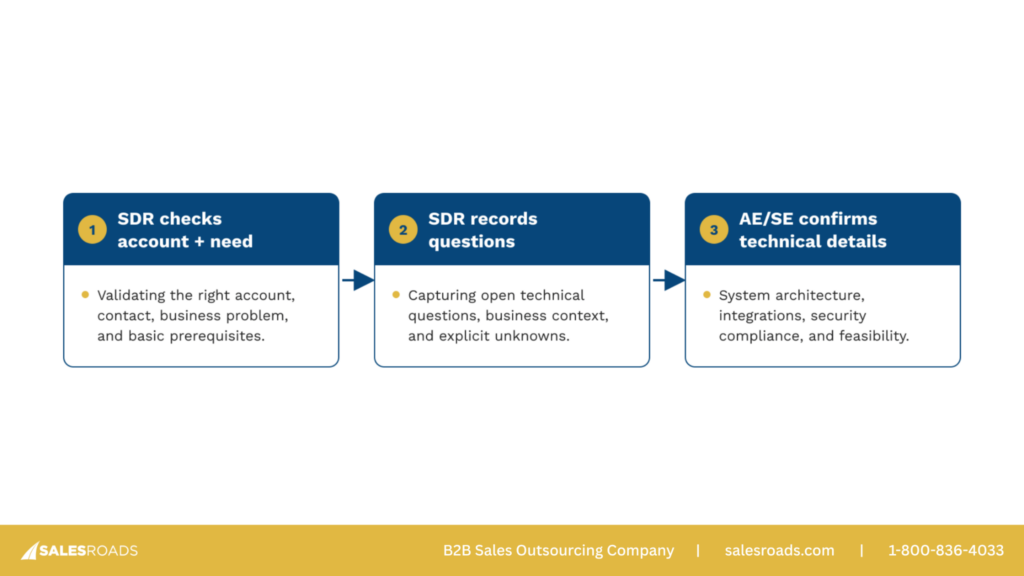
Follow this simple three-step rule to guide the process:
- The SDR focuses on what determines if the meeting should happen.
- They record any specific technical questions or constraints.
- They hand the process over to the specialist, who answers how the solution will work for the lead’s specific use case.
Adapt product knowledge by technology type
The information you need before the call depends on the type of tech product you’re selling.
| Technology type | Before the meeting | What the specialist handles later |
|---|---|---|
| SaaS and software | Use case, workflow, buyer role | Integrations, security, implementation |
| IT and infrastructure | Current setup, problem, planned change | Architecture, migration plan, system dependencies |
| B2B ISP and connectivity | Site/Address, broad bandwidth needed | Network design, redundancy, SLA details |
| Cybersecurity and compliance | Compliance framework, current tools, risk priority | Penetration testing, audit details, and network architecture |
| Hardware and IoT | Location, quantity, basic environment | Network topology, power requirements, and physical installation |
| Data and analytics | Current BI tools, primary data sources, and reporting needs | Data pipelines, warehousing architecture, and custom modeling |
What this sounds like on a real call
When a prospect asks a technical question, the SDR should acknowledge it, write down the details that matter, and make sure the right specialist is ready for the meeting. Reps can adapt the following examples to the buyer and their specific situation:
- Integration: If the buyer asks, “Does this integrate with our current ERP?” a safe response is, “I can capture what you’re using today and make sure our technical team addresses compatibility in the meeting. Which ERP are you running?”
- Security: For something like, “Can you support our SSO and security requirements?” the SDR could say, “I don’t want to guess on security requirements, so I’ll flag that for the right person. Is there a specific standard or requirement we should know about before the meeting?”
- ISP: When the lead asks, “Can you provide redundant circuits to both sites?” the SDR can confirm the locations, note redundancy as a requirement, and say, “Our technical team can validate route diversity and the service design. Which sites should they review?”
- Data migration: If the prospect asks, “How hard is it to move all our historical data?” the SDR might reply, “I can note your current system and data volume so our implementation team can walk you through our exact migration process. Roughly how many records are we talking about?”
- Hardware compatibility: For a question such as, “Will this work with our existing sensors?” the SDR might say, “I can record the specific models you’re using right now, and our technical team will verify the connection protocols before the meeting. What models are currently on the floor?”
- Compliance: If the buyer asks, “Do you meet our industry regulatory standards?” the SDR can state, “Our security specialist will cover our exact certifications on the call. Are there any specific audit frameworks you need us to review before we meet?”
The buyer should leave the conversation knowing exactly what will happen next. The SDR records the system involved, the site location, or the specific requirement, ensuring the specialist can provide an accurate technical answer later.
When SDRs need extra technical checks before booking
Standard appointment setting is usually enough when technical questions are rare and the team only needs to confirm the right account, the right contact, and a real business problem. However, you should add extra checks and escalation rules when:
- Technical prerequisites can immediately disqualify an account before the meeting.
- Buyers raise integration, security, deployment, or environment questions early in the process.
- Business and technical stakeholders need to hear the same core reason to act.
- AEs or solution engineers have limited time, making immediately rejected meetings particularly expensive.
- The product or market is still evolving, meaning feedback from outreach needs to reach sales, product, or technical teams quickly.
Mastering the Technical Sales Handoff
A successful technical sales handoff doesn’t happen by simply booking a meeting and tossing a few quick notes into your CRM. To prevent friction between your appointment setters and technical specialists, you need a structured approach that accurately assesses technical fit, aligns your messaging across different buyer roles, and clearly separates confirmed facts from open questions.
Assess prospects’ technical fit
A CRM field labeled “technical fit” is too vague. To help your SDRs, break this down into specific checks and write those rules into your lead qualification checklist so your team knows exactly what to verify and what to escalate.
Have your reps evaluate technical fit using specific questions like:
- Is there a simple prerequisite that the SDR is authorized to verify?
- Do we know enough about the buyer’s setup or requirements to invite the right specialist?
- Is there a technical unknown that should wait until deeper discovery?
- Has the seller accidentally turned a discovery topic into a pre-meeting hurdle?
Have your SDRs use this test to evaluate every situation. If the answer determines whether the account can reasonably use the product and the SDR is authorized to verify it safely, they should handle it before the meeting. If answering the question requires design work, a security review, a feasibility analysis, or another specialist decision, instruct your SDRs to simply record the question and route it to that specialist.
This approach protects your technical specialists’ time and ensures your SDRs aren’t asked to do the next seller’s job.
Keep the Message Consistent Across Business and Technical Roles
Technology purchases frequently involve a wide range of stakeholders, from business sponsors, technical evaluators, and end users to finance, legal, and security teams. However, the individuals with the greatest influence depend on the specific product, deal size, risk, and the current stage of the purchase. A larger buying group doesn’t automatically justify a higher volume of prospecting.
Your outreach can speak directly to each person but still fail to give the buying committee a shared reason to act. Because different roles bring different questions to the table, they’re looking at the same purchase from completely different angles.
For example, consider how priorities shift depending on the stakeholder you talk to:
- Business sponsors focus heavily on revenue growth, overall cost, speed to market, or team productivity.
- Technical evaluators prioritize system compatibility, technical feasibility, and potential implementation risks.
- Security teams analyze strict access controls, compliance standards, and potential data exposure.
- Finance and procurement evaluate final pricing, contract terms, and the overall purchasing process.
Reaching out to multiple people in the same account only helps when those individuals play a significant role in the final decision. Adding contacts just to increase your outreach activity metrics creates unnecessary noise without moving the deal forward.
Role-specific messaging works best when everyone hears the same core reason to act. If the buyer hears about one overarching problem, but the technical evaluator hears a completely different one, your sales team is telling two disconnected stories. Keep the core business problem consistent across all outreach, then tailor the specific details to each role.
That consistency makes the later handoff much cleaner. When the AE or specialist eventually enters the deal, they should immediately see who was contacted and how all those early conversations connect back to one unified buying problem.
Build the handoff around facts, questions, and unknowns
The next seller should know why the lead agreed to meet, what they said, and which specific technical questions still need an answer.
The handoff should move through a logical sequence to ensure nothing is missed. All relevant parties should know:
- The target account and role
- The business problem or reason for interest
- What the prospect said about their environment or constraints
- Open technical questions
- Explicit unknowns
- The purpose and attendees for the next meeting
- AE or SE answers and confirmations
- Feedback that changes the target list, messaging, or pre-meeting questions
A weak handoff can easily turn guesses into facts inside the CRM. For example, if an SDR hears that the prospect uses a particular system and automatically records an integration requirement, or hears a security concern and marks it as approved, they’re turning vague comments into concrete implementation dates. While the record looks complete on the surface, the next seller can’t tell what the buyer actually verified.
A strong handoff preserves the status of the gathered information. A simple CRM setup is usually enough, provided it clearly separates what your team knows, what the buyer said, and what a specialist still needs to confirm.
| Status | What it means |
|---|---|
| Known | Verified by your team |
| Prospect said it | The prospect said it; your team hasn’t checked it yet |
| Unknown | Not known yet. Don’t guess |
| Specialist confirmed | Confirmed during technical discovery |
You need to be clear about the purpose of the upcoming meeting as well. A first conversation could be a high-level introduction, a discovery call, a product demo, a technical review, or a trial-planning session. If the appointment setter expects a casual introductory call, but the AE prepares for an in-depth technical demo, even an account that perfectly matches your ideal customer profile can have a bad experience.
The handoff process should also send useful feedback to the outreach team. Sales leaders can use consistent patterns to refine who goes on the target list, what reps say, and what they ask before booking. For example:
- If the AE rejects the meeting because the account was out of scope, change the targeting rule.
- If the SE repeatedly finds the same technical issue that disqualifies or delays deals, add it to the pre-meeting questions when the SDR can check it safely.
- If prospects keep asking a question the SDR can’t answer, give reps an approved response and a clear escalation path.
How to Evaluate an Appointment Setting Partner for Technology Sales
When outsourcing your outreach, judge the provider by how it trains its reps, handles questions the team can’t answer, reviews calls, records information in the CRM, and uses rejected meetings to refine targeting or pre-meeting questions.
Key questions to ask include:
- How will you train your reps on our product, buyers, and approved claims?
- Which questions can reps answer, and which must be routed?
- What exactly counts as a qualified meeting?
- What information must be in the CRM before the meeting?
- How do rejected meetings and buyer feedback change the target list, messaging, or pre-meeting questions?
- Who owns “do not contact” lists, opt-outs, and other channel rules?
- What proof can we see, and what did the result measure?
It’s important to clarify the definition of a qualified meeting up front as well. One provider might simply count an introductory conversation with the right buyer, while another may require the buyer to state a specific business problem. Others could even require specific technical conditions or the AE’s acceptance before the meeting officially counts.
Our partnership with Bid Retriever shows how a tech sales B2B appointment setting process can make all the difference: SalesRoads trained SDRs on their specific SaaS product, used prospect feedback to refine targeting and product learning, and assisted with a CRM migration. As a result, Bid Retriever saw 1,164 appointments scheduled during our engagement with them.
The Bottom Line
Technology sales appointment setting uses core outreach fundamentals, but it requires your SDRs to know when and how to hand off complex questions to a specialist. If your team underqualifies an account, your AEs, specialists, and solution engineers waste time on meetings that shouldn’t have been booked. If they overqualify though, your appointment setters end up acting as a weak substitute for proper technical discovery.
Before your team scales its outbound activity, clearly define what information must be known before booking, which questions the SDR should record for a specialist, and what the next seller needs in the handoff notes. Then build those rules into your sales playbook and establish a clear process for how AEs will report back on accepted and rejected meetings to continually refine your targeting.
If you’re looking for a dedicated outbound partner, SalesRoads can help you run your outreach around how your sales team already works. Reach out to our team today to get started.
FAQs About B2B Technology Sales Appointment Setting
Can B2B technology appointment setting support inbound leads as well as cold outbound prospects?
Yes, technology appointment setting supports both inbound leads and cold outbound prospects effectively. The exact same pre-meeting checks and handoff rules apply to inbound leads, reactivation campaigns, and outbound efforts. While inbound leads already demonstrate some initial interest and outbound reps must first earn the conversation, the qualification process remains remarkably consistent across both channels.
What should go in the calendar invite for a technology sales meeting?
The calendar invite should make the meeting incredibly easy to understand before anyone joins the call. You should clearly outline the core purpose of the meeting, list the key attendees, detail the specific buyer problem, and include any confirmed facts about the account alongside the open technical questions the specialist needs to address.
Who should handle reschedules and no-shows after a technology sales meeting is booked?
Your appointment-setting team should normally own the confirmation process, handle any rescheduling needs, and manage all CRM updates until the meeting is successfully handed over to sales. You must notify the account executive or technical seller immediately when a meeting moves or falls through so they can protect their calendar.
Can technology appointment setting work with product-led growth or free trials?
Yes, this process works exceptionally well when prospects need specialized help that a self-serve product can’t provide. Scenarios like enterprise expansions, formal security reviews, complex implementation planning, multi-team rollouts, or complicated multi-system integrations frequently create compelling reasons to book a professional sales conversation even after a buyer starts a free trial.
How should appointment setting handle procurement or legal questions that come up early?
When these questions arise early, your SDRs should write down the specific issue and immediately route it to the appropriate sales, procurement, finance, or legal owner. The formal handoff notes must clearly state what the buyer asked, who raised the concern, and whether the question must be completely resolved before the next sales step.